

We can assure you, that we only place your backlinks in super high-quality PBN Networks that are both safe and reliable. With a limited amount of selling in each site.

PBNs can be quite tricky, and having been burned in the past I was very apprehensive. But their service happens to be quite safe as my website has not seen any penalties. On the contrary, we’ve seen an increase in rankings.

I must say, quite an affordable service for the quality delivered. The links are well placed and the websites look genuine for the most part. I’ll be back again.
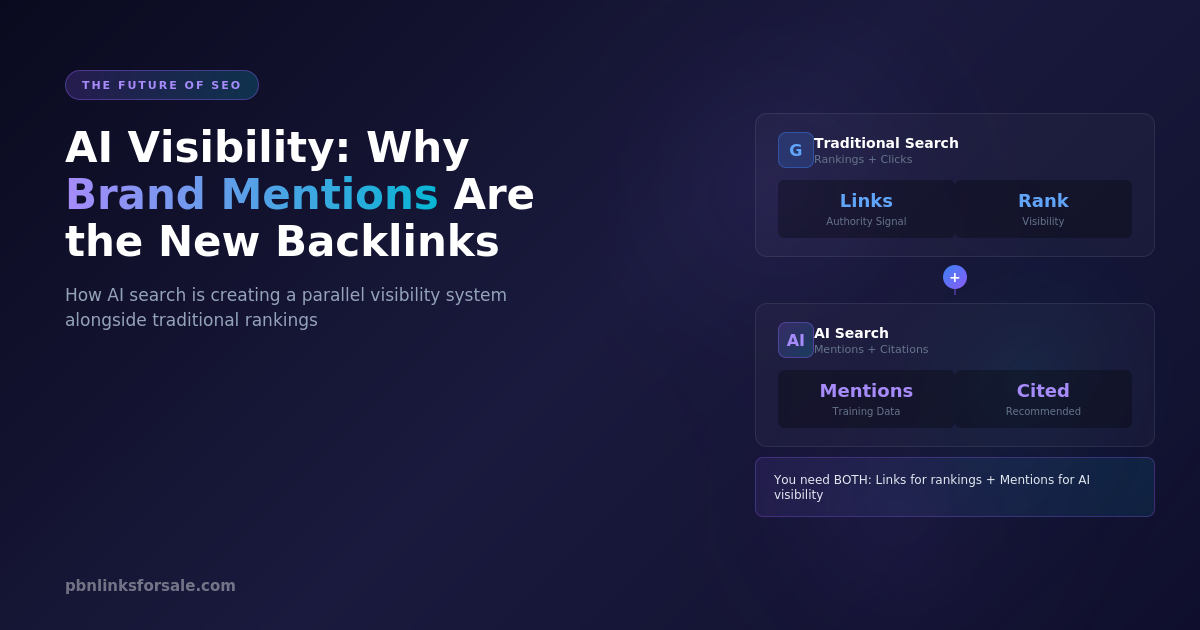
Search is fragmenting. For two decades, SEO meant optimising for Google. Build links, improve rankings, capture traffic from the search engine that controlled over 90% of queries. That model isn't dying, but it's no longer the complete picture.
ChatGPT answers questions without sending users to websites. Perplexity summarises information from across the web with inline citations. Google's own AI Overviews synthesise answers at the top of search results, often eliminating the need to click through. Microsoft's Copilot, Anthropic's Claude, and a growing ecosystem of AI assistants are becoming primary information sources for millions of users.
This shift has profound implications for anyone whose business depends on search visibility. The skills that built rankings in the link-driven era remain relevant, but they're no longer sufficient. A new dimension of visibility is emerging—one where being mentioned, cited, and recognised by AI systems matters as much as ranking in traditional search results.
This piece examines what's actually changing, what it means for link building strategy, and how to position your brand for visibility in an AI-augmented search landscape. Not speculation about distant futures—practical analysis of shifts happening right now.
Understanding the mechanics helps clarify why strategy needs to evolve. Traditional search and AI-powered search operate on fundamentally different principles.
Google's core model indexes web pages, evaluates them against hundreds of ranking factors, and presents ordered results. Users scan the list, click through to websites, and find information on those pages. The search engine is an intermediary connecting queries to destinations.
Links function as votes of confidence in this model. A page with more high-quality backlinks signals to Google that other sites consider it valuable. PageRank and its successors use link graphs to determine authority. Building links directly improves your position in the ranked list.
The goal is capturing clicks. Ranking first means capturing the majority of traffic for a query. Every position gained represents measurable increases in visitors, leads, and revenue. SEO success is quantifiable through rankings and organic traffic.
AI systems work differently. They don't rank pages—they synthesise answers. When you ask ChatGPT a question, it doesn't return a list of websites. It generates a response based on patterns learned during training, potentially augmented by real-time retrieval from the web.
The training process itself matters enormously. Large language models learn from massive text datasets scraped from the web. If your brand, products, or expertise appear frequently in that training data—in articles, discussions, reviews, and references across the internet—the AI "knows" about you. It can mention you in relevant contexts, recommend you when appropriate, and treat you as a legitimate entity in your space.
If your brand rarely appears in training data, the AI may not know you exist. It can't recommend what it doesn't know. It can't cite expertise it hasn't encountered. Invisibility in training data translates to invisibility in AI-generated responses.
Real-time retrieval adds another layer. Systems like Perplexity and Google's AI Overviews actively search the web when generating responses. They pull information from current pages, summarise it, and cite sources. Being retrievable and citable when these systems search becomes a new form of visibility.
When AI systems cite sources, they create a new type of valuable reference. A Perplexity answer citing your article sends traffic directly. A ChatGPT response mentioning your brand by name builds awareness even without a link. A Google AI Overview pulling information from your page—with a small citation link—captures some of the visibility that would previously have required ranking in the blue links.
These citations function similarly to backlinks but operate through different mechanisms. Traditional links pass PageRank and influence rankings. AI citations influence what the AI says and recommends. Both represent external validation that affects visibility, but they flow through different channels.
The implication is significant: you need to be linkable AND citable. Optimising only for traditional rankings increasingly means optimising for a shrinking portion of total search behaviour.
In the traditional SEO model, unlinked brand mentions had limited direct value. Google might use them as minor trust signals, but without a hyperlink, no PageRank flowed. The focus was on converting mentions into links.
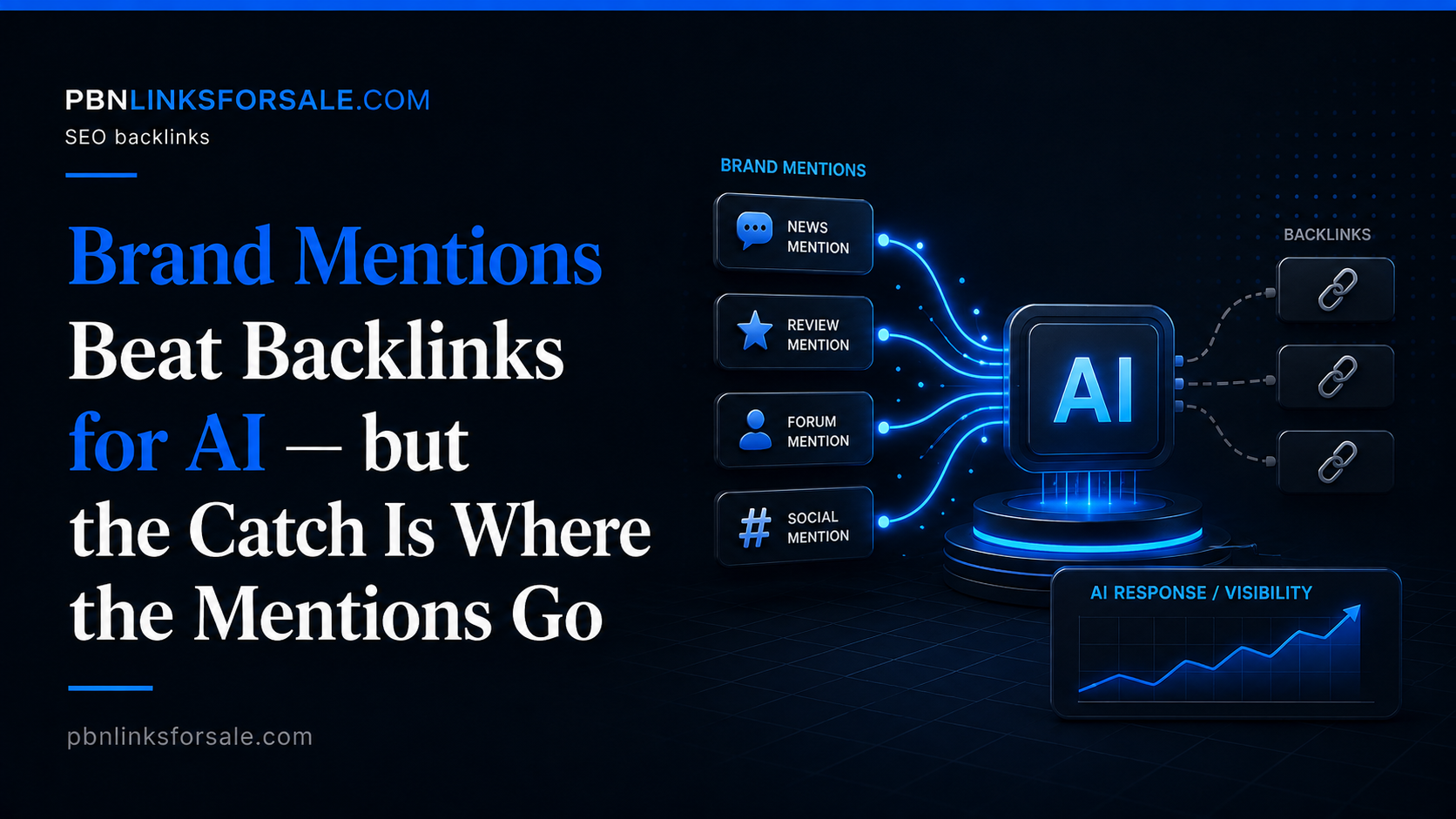
AI systems change this calculation entirely. Mentions in training data influence what AI systems know and say regardless of whether they're hyperlinked. A brand discussed frequently across forums, articles, and reviews becomes embedded in the AI's knowledge—with or without links accompanying those mentions.
Large language models are trained on snapshots of internet text. The Common Crawl dataset, Wikipedia, books, articles, forum discussions—all of this forms the foundation of what AI systems "know." When your brand appears in this training data in positive, authoritative contexts, the AI learns to associate your brand with those qualities.
Ask ChatGPT to recommend a CRM system, and it will name options it encountered frequently during training. Ask for the best hiking boots, and it will suggest brands that appeared in gear reviews and outdoor forums. The AI's recommendations reflect its training data's contents and associations.
This creates a new imperative: brand presence across the web matters even when that presence doesn't include direct links to your site. Being discussed, reviewed, mentioned, and referenced builds the foundation of AI visibility. The mentions that previously seemed like nice-to-haves become strategic assets.
Here's something most SEOs haven't fully processed: Google itself is now prioritising user-generated content from platforms like Reddit and Quora. We explored this shift in depth in our analysis of why Google is ranking Reddit and Quora above traditional websites. The implications for AI visibility are even more pronounced.
AI systems heavily weight forum discussions in their training data. These platforms represent authentic human conversation and recommendation—exactly what AI models are trying to learn from and replicate. When your brand is mentioned positively in Reddit threads, Quora answers, and industry forums, you're building the exact type of presence that influences AI recommendations.
This creates a feedback loop. Google surfaces forum content prominently. AI systems train on that content. Users see your brand in both contexts. The visibility compounds across both traditional and AI-mediated search.
Modern AI systems increasingly augment their base knowledge with real-time retrieval. When Perplexity answers a question, it searches the current web and synthesises results. When Google generates an AI Overview, it pulls from indexed pages. These retrieval systems favour content that's authoritative, clearly written, and directly answers likely questions.
Content optimised for traditional SEO often works well for retrieval, but the emphasis shifts. Comprehensive, authoritative content that thoroughly covers a topic becomes more valuable than content optimised narrowly for specific keywords. This connects to what we've always said about the relationship between content and link building—quality content has always been foundational, but AI retrieval makes it even more critical.
Being cited by AI retrieval systems provides visibility that doesn't depend on ranking position. Even if you're not in the top three organic results, an AI system might pull information from your page and cite it in the generated answer. This creates alternative pathways to visibility.
When an AI assistant recommends your brand or cites your content, it transfers trust. Users increasingly treat AI responses as authoritative. A recommendation from ChatGPT carries weight similar to a recommendation from a knowledgeable friend—arguably more weight than a Google search result, which users have learned to view with scepticism.
This trust transfer operates independently of your website's search rankings. You could rank tenth for a query but be the brand the AI recommends when asked directly. The AI's endorsement bypasses traditional ranking competition entirely.
Building the brand presence that earns AI recommendations requires the same fundamental activities that build traditional authority: being genuinely good at what you do, being discussed and recognised in your industry, earning coverage and mentions from respected sources. But the payoff now extends beyond link-driven rankings into AI-mediated visibility.
Link building isn't becoming irrelevant. Traditional search still dominates query volume, and links remain fundamental to how Google evaluates authority. But link building strategy needs to expand to account for AI visibility.
Let's be clear: reports of link building's death are premature. Google's ranking algorithms still weight backlinks heavily. Competitive queries still require competitive backlink profiles. The sites winning organic rankings in 2026 are still, overwhelmingly, sites with strong link portfolios.
Nothing about AI search changes this reality for traditional rankings. If you want to rank in Google's organic results, you need links. Quality links from relevant, authoritative sources. Diverse link profiles that look natural. All the principles that have governed effective link building for years remain valid. The metrics that indicate link quality still matter for traditional search.
The shift isn't from links to mentions—it's from links alone to links plus mentions. You need both. Abandoning link building because "AI is the future" would be strategic malpractice.
The strategic expansion involves pursuing brand mentions and citations alongside traditional links. This means valuing placements that might not include dofollow links but generate brand visibility in contexts AI systems will encounter.
Industry forums where experts discuss tools and services. Reddit threads comparing options in your category. Quora answers mentioning your brand as a solution. Product reviews on YouTube and podcasts. News coverage that names your company. Social media discussions that reference your offerings.
These placements may not pass PageRank. They may not directly improve your rankings. But they build the web presence that influences what AI systems know and recommend. They become part of the training data or retrieval corpus that shapes AI-generated responses.
Practically, this means adjusting how you evaluate opportunities. A mention in a popular industry forum might be worth pursuing even without a link. A podcast appearance reaches audiences and generates transcripts that AI systems may process. A guest post that only includes a nofollow link still creates a brand mention in authoritative content.
News coverage has always been valuable for brand building. In the AI era, it becomes even more strategic. News articles are heavily weighted in AI training data—they represent authoritative, fact-checked information that AI systems are designed to learn from and reference.
When your brand appears in news coverage—whether through premium press release distribution, earned media, or industry news features—that coverage enters the knowledge base AI systems draw from. The brand mention becomes embedded in what AI "knows" about your space.
This is particularly valuable for establishing expertise in specific verticals. Industry-specific news coverage signals to AI systems that your brand is a legitimate player in that space. When users ask AI assistants for recommendations in your category, that news presence influences whether you're mentioned.
For sectors like cryptocurrency and blockchain, where AI systems are frequently asked for project recommendations and analysis, targeted crypto press release distribution becomes a direct investment in AI visibility. The coverage reaches both human audiences through traditional channels and AI systems through training data inclusion.
"Best of" lists, comparison articles, and recommendation roundups are AI visibility gold. These formats directly mirror how AI systems respond to recommendation queries. When an AI is asked "What are the best tools for X?", it's essentially generating its own listicle based on training data—and that data heavily includes existing listicle content.
Securing placement in authoritative listicles means your brand appears in the exact content format AI systems reference when generating recommendations. Premier listicle placements on high-authority sites create mentions that influence both traditional search (through the link and ranking benefits) and AI search (through training data inclusion).
The compounding effect is significant. Appearing in multiple authoritative listicles creates a pattern that AI systems recognise. Your brand becomes associated with being a recommended option in your category. That association persists across AI-generated responses.
Creating content specifically optimised for AI citation is an emerging discipline. While the exact factors that influence AI retrieval are less documented than Google's ranking factors, patterns are emerging.
Comprehensive, authoritative content performs well. AI systems seeking information to synthesise prefer sources that thoroughly cover topics. Thin content targeting narrow keywords gets passed over in favour of substantial resources.
Clearly structured content gets cited more accurately. When AI systems can easily parse headings, sections, and key points, they can extract and cite information precisely. Poorly structured content leads to confused citations or no citation at all.
Factual, quotable statements increase citation likelihood. AI systems looking for specific answers favour content that provides clear, direct statements. "The average X is Y" gets cited. Vague generalities get ignored.
Original data and research earn disproportionate citations. AI systems distinguish between primary sources and content that merely summarises other sources. Original research, proprietary data, and unique insights position you as a source worth citing rather than another voice repeating what others have said.
The most effective approach combines traditional link building with brand presence development. Neither alone is sufficient; together they create visibility across both traditional and AI-mediated search.
Traditional high-quality backlinks remain the foundation. Guest posts on authoritative sites, niche edits in established content, PBN links from quality networks—these drive traditional rankings and provide the authority signals Google's algorithms still require.
Don't reduce investment in foundation links. If anything, the fragmentation of search makes traditional rankings more valuable for the traffic they still capture. When AI answers satisfy some queries directly, the queries that do result in clicks become more valuable.
Layer AI-focused visibility activities on top of traditional link building. This is a distinct category of work we've been developing as AI visibility stacks—combinations of placements specifically designed to build presence in the content AI systems learn from and cite.
Press coverage that establishes authority in your vertical. Listicle placements that associate your brand with being a recommended option. Forum and discussion presence that creates authentic social proof. Review and comparison inclusion that influences purchase recommendations.
These placements work differently than traditional links. They may not move rankings directly. But they shape what AI systems know and recommend—an increasingly important factor in how people discover and choose solutions.
Create content specifically designed to be cited. This goes beyond standard SEO content into resource development:
Original research reports with unique data. Industry surveys, benchmarking studies, trend analyses based on proprietary information. These become citation magnets for both human writers and AI systems.
Comprehensive guides that become reference standards. Not thin keyword-targeted pages, but definitive resources that thoroughly cover important topics. These establish your site as an authority that AI systems recognise and cite.
Tools and resources that solve real problems. Calculators, templates, frameworks—practical utilities that users and AI systems recommend when people need solutions.
Expert commentary on current events and trends. Timely perspectives on industry developments that journalists, writers, and AI systems reference when covering topics in your space.
Traditional SEO metrics—rankings, organic traffic, backlink counts—remain relevant but increasingly incomplete. Measuring AI visibility requires additional approaches.
The most direct method is simply asking AI systems about your space and observing whether you're mentioned. Query ChatGPT, Claude, Perplexity, and other assistants with questions your target customers might ask. Are you recommended? Are competitors mentioned instead? How does the AI characterise your brand when it does mention you?
This testing isn't perfectly scientific—AI responses vary based on phrasing, context, and system versions. But patterns emerge. If you're consistently absent from responses where competitors appear, that's actionable intelligence. If you're mentioned but characterised incorrectly, that indicates brand presence work needed.
Document these queries and responses over time. Track whether your visibility improves as you implement brand presence strategies. Build a baseline understanding of where you stand in AI awareness.
Monitor brand mentions across the web beyond traditional backlink tracking. Tools like Mention, Brand24, or Google Alerts surface discussions that may not include links. Track volume trends, sentiment, and context of mentions.
Pay particular attention to mentions in content types that feed AI training: forums (Reddit, Quora, industry-specific communities), news and media coverage, review sites and comparison content, educational resources and tutorials.
Increasing brand mention volume and improving mention sentiment across these sources correlates with improved AI visibility over time, though the relationship isn't immediate—AI systems update their knowledge periodically rather than continuously.
Watch your referral traffic for signals of AI-driven discovery. Some AI systems include clickable citations that drive traffic. While this traffic may appear as direct or referral depending on implementation, patterns can indicate AI-mediated discovery.
Traffic from Perplexity appears as referral traffic and can be tracked directly. Traffic from users who encountered your brand via ChatGPT and then navigated to your site appears differently—often as direct traffic or branded search.
Branded search volume itself becomes a metric worth monitoring. Increases in branded searches may indicate AI systems mentioning your brand, prompting users to search for you directly. This represents a new pathway from AI visibility to website visits.
Predicting technology trajectories is notoriously unreliable, but certain trends appear durable:
AI integration in search will deepen, not recede. Google, Microsoft, and independent players are all investing heavily. The percentage of queries that receive AI-generated responses will increase. Optimising for this reality isn't optional.
Traditional organic results aren't disappearing. They're being supplemented, not replaced. There will be queries where users want curated lists of websites. There will be searches where AI can't provide satisfactory synthesis. Traditional rankings remain valuable even as their share of total visibility decreases.
Brand matters more in an AI-mediated world. When AI systems recommend options, they tend toward brands they've encountered frequently in positive contexts. Being known—having genuine presence and reputation—translates directly to AI visibility. Generic sites without brand recognition struggle to earn AI mentions.
The definition of "SEO" is expanding. It's no longer just search engine optimisation—it's search and AI optimisation. The skillset that drives visibility in 2026 and beyond includes traditional technical SEO, link building, content creation, AND brand presence development AND AI citation optimisation.
Tactical recommendations for adapting your approach:
Continue building quality links. Don't abandon what works for traditional search. Diversified link building remains foundational. The sites winning organic rankings are still the sites with strong backlink profiles. AI visibility supplements but doesn't replace link-driven authority.
Audit your brand presence. Search for your brand across forums, review sites, comparison content, and discussions in your space. Are you present? Are mentions positive? Identify gaps where competitors appear but you don't.
Test your AI visibility. Query AI assistants with questions your customers ask. Document whether and how you're mentioned. Repeat quarterly to track changes. Build understanding of where you stand versus competitors.
Invest in press coverage. News mentions and press coverage feed AI training data directly. Strategic press distribution creates mentions that persist in AI knowledge bases.
Secure listicle placements. Recommendation roundups and "best of" lists directly influence how AI systems respond to product and service queries. Being included in authoritative lists creates compounding AI visibility.
Create citable content. Invest in original research, comprehensive guides, and resources that AI systems will cite as authoritative sources. Position your site as a primary source, not a summariser of others' work.
Track broader metrics. Monitor branded search volume, brand mention trends, and referral patterns alongside traditional SEO metrics. These indicators reveal AI-mediated visibility that rankings alone don't capture.
Search is evolving. The single channel that dominated digital discovery for two decades is fragmenting into multiple pathways—traditional rankings, AI-generated answers, voice assistants, recommendation engines. Visibility strategy must evolve accordingly.
Links remain essential. They still drive traditional rankings. They still signal authority. They still generate referral traffic. Nothing in the AI shift diminishes the value of a strong backlink profile for the queries that still result in organic clicks.
But links alone are no longer enough. Brand mentions, AI citations, and presence across the web's knowledge base now contribute to a parallel visibility system. Optimising for one while ignoring the other leaves value on the table.
The brands that thrive in this new landscape will be those that understand both systems and build presence in both. They'll invest in links AND mentions, in rankings AND citations, in traditional SEO AND AI visibility. They'll recognise that being known—truly known, widely discussed, frequently mentioned—has become a direct driver of discovery.
Whether you're building links yourself or working with partners who handle it, make sure your strategy accounts for both the present reality of link-driven rankings and the emerging reality of AI-mediated discovery. The search landscape is expanding. Your visibility strategy should expand with it.


2025 © Copyrights PBN Links For Sale

Stop struggling with SEO. Our expert team will analyze your website and create a custom backlink strategy that delivers real results. Get more traffic, more leads, and more revenue.
Take the first step towards expanding your business online with our Backlinks services. We work with many private individuals and SEO agencies. We can help you take care of all your Backlink needs and rank your websites correctly. Boost your website's rankings today!


Find the perfect solution for your SEO and link building needs
Browse our full range of quality backlinks and SEO services
Shop NowComplete packages for every budget and ranking goal
View PackagesWhite-label solutions for agencies and resellers
Agency PlansProfessional SEO services at competitive prices
Learn More