

We can assure you, that we only place your backlinks in super high-quality PBN Networks that are both safe and reliable. With a limited amount of selling in each site.

PBNs can be quite tricky, and having been burned in the past I was very apprehensive. But their service happens to be quite safe as my website has not seen any penalties. On the contrary, we’ve seen an increase in rankings.

I must say, quite an affordable service for the quality delivered. The links are well placed and the websites look genuine for the most part. I’ll be back again.
You're paying your SEO agency thousands per month. Part of that retainer covers "link building." They send you a monthly report showing new backlinks acquired. The numbers look reasonable. Your rankings are... fine. Maybe improving, maybe not.
But do you actually know what's happening behind those reports? Where those links come from? What your agency is really doing with the link building portion of your budget?
We work with SEO agencies. We see their operations from the inside. We know what many of them don't tell their clients—not necessarily because they're dishonest, but because transparency in link building creates uncomfortable conversations most agencies prefer to avoid.
This piece pulls back the curtain. Not to vilify agencies—many do excellent work—but to help you understand what questions to ask, what to look for, and how to evaluate whether you're actually getting value from your link building investment.
Let's start with the most straightforward issue: what you pay for links versus what your agency pays.
Most agencies don't build links themselves. They don't have proprietary networks. They don't maintain relationships with hundreds of publishers. They outsource to link building specialists—companies like ours, freelancers, or other providers—and mark up the cost.
This isn't inherently wrong. Agencies provide value through strategy, coordination, reporting, and expertise. Markup is how service businesses work. But the gap between what you pay and what links actually cost is often larger than clients realise.
A typical agency marks up link costs by 100-300%. Sometimes more. A link that costs £150 to acquire might appear on your invoice bundled into a £500 "content placement" or "outreach" line item. A £200 guest post becomes part of a £800 "content marketing" deliverable.
The markup itself isn't the problem. The problem is when the markup is so large that it dramatically limits how many quality links you actually receive. If you're paying £3,000/month for "link building" but only £500-800 of that goes toward actual link acquisition, you're getting far fewer links than you could afford through direct purchasing—even accounting for the value of agency strategy and management.
The math matters. Link building is partially a volume game—you need enough quality links to move rankings in competitive spaces. If your budget is being absorbed primarily by agency overhead rather than actual link acquisition, your campaign is handicapped from the start.
Consider two scenarios. Agency A charges £3,000/month for link building, keeps £2,200 for overhead and profit, and spends £800 on links. You might get 4-6 decent links per month. Agency B charges £3,000/month, keeps £1,200, and spends £1,800 on links. You might get 10-15 decent links per month.
Same budget. Dramatically different outcomes. And you'd never know the difference from the monthly report, which might show similar-looking deliverables presented with different levels of detail.
Here's where things get murkier. Even agencies with reasonable markups often play games with link quality that clients never see.
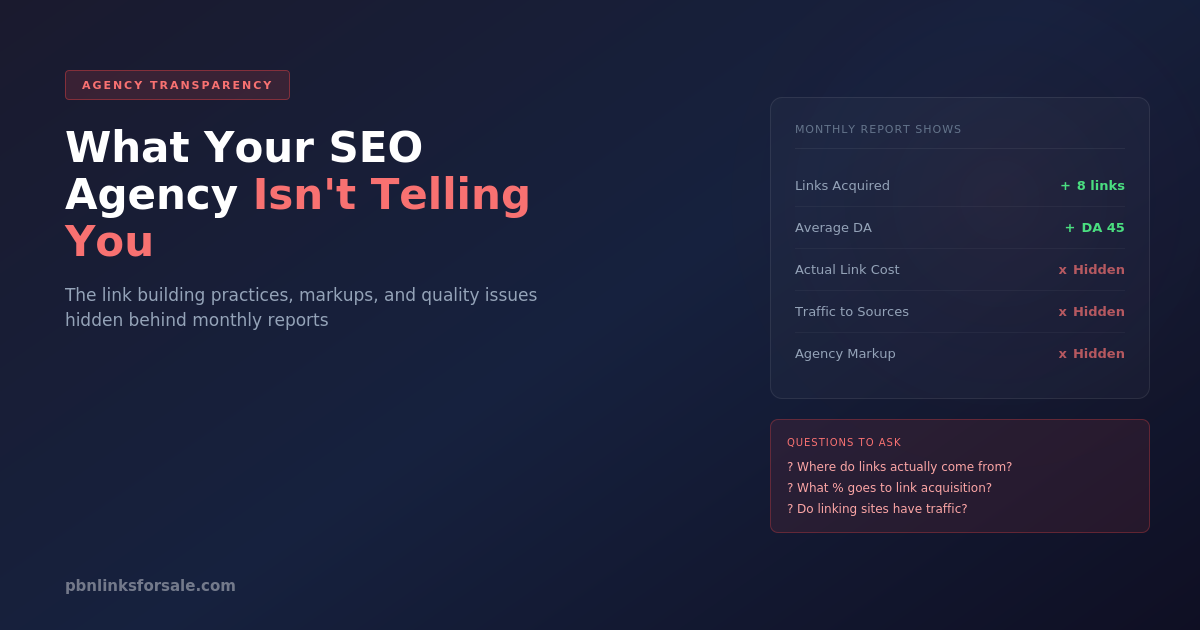
Agency reports typically highlight Domain Authority, Domain Rating, or similar metrics. "We acquired 8 links this month averaging DA 45." Sounds good. But as we've discussed in our analysis of link building metrics that actually matter, these numbers can be deeply misleading.
Domain metrics are easily inflated. Sites can artificially boost their DA or DR through link schemes specifically designed to game these third-party scores. A site showing DA 50 might have achieved that through manipulative link building that provides no actual ranking benefit—and Google may have already devalued it.
Traffic tells a truer story. Does the linking site receive organic traffic? Has Google decided it deserves to rank for something? If a DA 50 site has zero organic traffic, Google has effectively declared it worthless despite the impressive-looking metric. The link from that site carries minimal value.
Agencies know this. Many clients don't. The reports emphasise metrics that look good rather than metrics that indicate actual value.
Topical relevance significantly impacts link value. A link from a site closely related to your niche carries more weight than a link from an unrelated site with superior metrics. Google's algorithms understand context—a link makes more sense, and transfers more authority, when it comes from a topically connected source.
But relevant links are harder to acquire and often more expensive. It's easier and cheaper for agencies to place links on general sites that accept content from any industry. A "lifestyle" blog that publishes about everything from finance to pet care to technology will accept your link—but the topical relevance is weak.
Agency reports rarely address relevance directly. They might show the linking domain and its metrics, but they won't highlight that the "health and wellness" site also published articles about cryptocurrency, plumbing, and car insurance last week. The client sees a link from a DA 40 site. The client doesn't see that the link's value is diminished by poor topical alignment.
Where a link appears on a page affects its value. A link within the main content, surrounded by relevant text, carries more weight than a link buried in an author bio, sidebar, or footer. Google's systems evaluate link context—links that appear naturally within content signal editorial endorsement more strongly than links that appear in templated locations.
Many agency-acquired links appear in author bios or contributor boxes. "John Smith is a marketing consultant. Visit his website at [your link]." These are the easiest placements to acquire—often included automatically when content is accepted—but they're also the weakest in terms of link value.
Reports typically don't distinguish between contextual links and bio links. A link is a link in the deliverables column. The quality differential goes unmentioned.
Most agencies outsource link building. This is normal—specialisation exists for good reasons. The question is who they outsource to and how many layers exist between your money and actual link placement.
You pay Agency A. Agency A subcontracts to Link Building Company B. Company B sources some links from Network C and outsources other links to Freelancer D who uses Marketplace E.
Each layer takes margin. Each layer adds communication friction. Each layer creates opportunities for quality to degrade. By the time your budget reaches actual link placement, it's been sliced multiple times—and no one in the chain has strong incentive to prioritise your specific results over their own margin.
The compounding effect is significant. We've written about the real cost of cheap PBN links—when agencies chase the cheapest possible link sources to maximise their own margin, the client bears the risk. Low-cost links often mean low-quality sites, thin content, and network footprints that Google can detect.
Agencies rarely reveal their supply chain. Asking "who actually places these links?" often produces vague answers about "our network of publishers" or "proprietary relationships." The opacity isn't always malicious—some agencies genuinely don't know the details of their suppliers' operations—but it leaves you unable to evaluate the actual quality of what you're buying.
We see the aftermath regularly. Sites hit by algorithm updates. Clients who come to us after their agency's links were deindexed or devalued. Backlink profiles full of placements on sites that no longer exist, sites that pivoted to spam, or networks that Google identified and neutralised.
The agency has usually moved on by then. The monthly reports showed deliverables being met. The retainer was paid. When the links lost value months or years later, the agency wasn't held accountable—the client just saw rankings decline without understanding why.
This isn't universal. Good agencies vet their suppliers carefully, monitor link quality over time, and maintain relationships with reliable providers. But distinguishing between agencies that prioritise quality versus those that prioritise margin requires asking questions most clients don't think to ask.
Monthly reports are designed to look good. This isn't necessarily dishonest—reports should highlight progress and achievements. But the information included (and excluded) often obscures more than it reveals.
Common report elements that look impressive but reveal little: Total number of backlinks acquired (without quality differentiation). Average Domain Authority of new links (easily gamed metric). Number of "outreach emails sent" (activity metric, not outcome metric). "Impressions" or "reach" of placed content (rarely translates to link value).
What's usually missing: Organic traffic to linking pages (indicates actual Google trust). Topical relevance assessment (indicates contextual value). Link placement location (in-content vs bio/footer). Historical stability of linking domains (indicates longevity risk). Comparison to competitor link acquisition (indicates competitive positioning).
Agencies report what makes them look productive. The metrics that would reveal link quality—or lack thereof—rarely appear.
Many agencies bundle link building with other services in ways that make evaluation impossible. "Content marketing" might include link building, but how much? "SEO services" might include outreach, but what percentage of the budget?
This bundling serves agency interests. It prevents direct comparison of link building costs with alternatives. It makes it harder to attribute results to specific activities. And it allows reallocation of budget between activities without client visibility.
If your agency can't tell you specifically how much of your monthly retainer goes to link acquisition versus other activities, that opacity exists for a reason. It may be operational convenience, but it also prevents accountability.
"Your rankings improved this month" sounds great. But was that because of the links they built? Technical improvements they made? Content they published? Natural fluctuations? Competitor mistakes?
SEO results are genuinely difficult to attribute to specific activities. But that difficulty also provides cover for underperforming link building. As long as overall rankings trend vaguely upward, agencies can claim their links contributed—even if those links had minimal actual impact and other factors drove the improvement.
The reverse is equally problematic. When rankings stall or decline, agencies can point to algorithm updates, competitor activity, or content issues rather than examining whether their link building approach is actually working.
Beyond the structural issues, there are specific things agencies avoid telling clients directly.
Most agency link building involves paying for placements—whether directly purchasing links, paying for guest post opportunities, or exchanging value for coverage. This is the reality of competitive link building in 2026.
But many agencies present their link building as purely "outreach" or "digital PR" or "content marketing." They avoid explicitly stating that money changes hands for placements. This isn't always client-facing deception—some agencies genuinely believe the distinction matters, or they're navigating Google's guidelines language carefully.
The practical reality: if your agency is acquiring links consistently and predictably, they're almost certainly paying for them in some form. The question isn't whether money is involved—it's whether they're paying enough for quality, or cutting corners to maximise margin.
Link permanence is never guaranteed. Sites change ownership. Publishers remove old content. Guest post sections get cleaned out. Networks get detected and devalued. The links you're paying for today might not exist—or might not carry value—a year from now.
Agencies rarely discuss link longevity. Reports show what was acquired, not what was lost. Clients see net additions without visibility into attrition. And when significant links disappear or get devalued, the connection to previous reporting often goes unmentioned.
This connects to a broader issue we've explored: link decay and why backlinks lose value over time. Link building isn't a one-time effort—it requires ongoing investment to maintain and grow authority. Agencies selling "we'll get you ranking" without discussing maintenance are setting unrealistic expectations.
Agencies often avoid direct conversations about budget limitations. If you're paying £2,000/month for comprehensive SEO and expecting to compete in a space where competitors invest £10,000/month in link building alone, you're not going to win. But saying that directly risks losing the client.
Instead, agencies set vague expectations, promise "strategic" approaches, and hope incremental progress keeps clients satisfied long enough. When progress stalls, they'll suggest increasing budget—but they won't be transparent upfront about what's actually required to compete.
This isn't always deliberate manipulation. Many agencies genuinely try to deliver value at every budget level. But avoiding honest budget conversations leads to misaligned expectations and eventual disappointment.
Armed with this understanding, here are specific questions to ask your agency—or to evaluate before hiring one:
"What percentage of my retainer goes directly to link acquisition?" Not strategy, not reporting, not overhead—actual link purchasing. If they can't answer specifically, that's telling. If the number is below 40-50% for a link-building-focused engagement, you're paying primarily for management rather than links.
"Who actually places the links?" Is it done in-house? Outsourced to a specific provider? Multiple providers? How many layers exist between your payment and actual placement? The more layers, the more margin erosion and quality risk.
"Can I see traffic data for linking domains, not just DA/DR?" Agencies that focus exclusively on domain metrics may be hiding that their links come from sites Google doesn't actually trust. Traffic data reveals whether Google sends visitors—a much better quality indicator.
"How do you evaluate topical relevance?" A good answer involves specific criteria for matching linking sites to your industry. A bad answer is vague references to "quality sites" without relevance standards.
"What happens when links are removed or devalued?" Good agencies monitor link status and report losses alongside gains. They may offer replacement guarantees. Agencies that don't track link attrition aren't managing your profile—they're just selling placements.
"How does my link building compare to my top competitors?" Competitive context matters. If competitors acquire 20 quality links monthly while you get 5, you're falling behind regardless of what your reports show. Good agencies benchmark against competition.
"What's your replacement or guarantee policy?" If a link disappears within 6-12 months, what happens? Agencies confident in their link sources will stand behind them. Those using questionable sources won't offer guarantees.
Not every agency relationship needs to end. Some agencies provide genuine value—strategic guidance, competitive analysis, coordinated campaigns that integrate link building with content and technical SEO. The oversight and expertise justify their margin.
But in some situations, going direct makes more sense:
When link building is your primary need. If you have technical SEO handled, content production sorted, and primarily need link acquisition, paying agency markup for coordination you don't need wastes budget. Direct purchasing from link building specialists—whether us or others—stretches the same investment further.
When you can manage the process. If you or someone on your team can evaluate link quality, plan campaigns, and coordinate execution, you don't need to pay agency rates for that management. Use the savings to buy more or better links.
When transparency matters. Direct relationships provide visibility agency layers obscure. You know exactly what you're paying for each link. You can evaluate sources directly. You maintain control over where your links come from.
When your agency's results don't justify their cost. If monthly reports show activity without corresponding ranking improvements, if link quality seems suspect, if you can't get straight answers to reasonable questions—these are signals that your money might be better spent elsewhere.
This piece might sound anti-agency. It's not—we work extensively with SEO agencies who outsource link building to us. The good ones maintain healthy margins while still delivering quality to their clients. They're transparent about what link building involves. They vet their providers carefully. They focus on sustainable results rather than impressive-looking reports.
The issue isn't agencies as a model—it's opacity within that model. Clients deserve to understand what they're paying for. Agencies that provide genuine value shouldn't fear transparency. Those that rely on information asymmetry to maintain margins are the ones who should worry.
If you run an agency and you're reading this thinking "we're not like that"—great. You probably aren't. The agencies that prioritise client results over short-term margin extraction build better businesses anyway. But your potential clients are reading articles like this because they've been burned before, or they sense something isn't right with their current provider. Understanding their scepticism helps you address it.
Whether you work with an agency or go direct, here's what quality link building involves:
Transparent sourcing. You should know—or be able to know—where your links come from. Not every specific site in advance, but the types of sites, the quality standards, and the acquisition methods. Mystery boxes create risk.
Quality over quantity. Five excellent links beat fifty mediocre ones. The emphasis should be on acquiring links that actually move rankings—which means considering traffic, relevance, placement, and authority holistically rather than chasing metric numbers. Understanding how to evaluate link quality properly is fundamental.
Diverse acquisition. Natural backlink profiles include variety—different site types, different link types, different acquisition timelines. Profiles built entirely from one source or method look artificial because they are. A mix of guest posts, niche edits, PBN links, and other types creates natural-looking diversity.
Competitive awareness. Link building doesn't happen in a vacuum. What matters is how your link profile compares to competitors. Good providers help you understand the competitive landscape and what's required to close gaps or maintain advantages.
Realistic timelines. Links take time to impact rankings. New links need to be indexed, their value needs to be calculated, and rankings need to adjust. Anyone promising immediate results either doesn't understand how SEO works or is using manipulative short-term tactics with long-term risk.
Ongoing monitoring. Link building isn't fire-and-forget. Links need to be verified, attrition needs to be tracked, and the profile needs ongoing maintenance. Providers who disappear after delivery aren't protecting your investment.
The goal of this piece isn't to make you distrust all agencies. It's to help you evaluate them—and alternatives—with clearer understanding of how the industry actually works.
Some agencies provide tremendous value. They bring strategic thinking, coordinate complex campaigns, and deliver results that justify their margins. If that describes your agency, excellent—but you should still understand what you're paying for and why.
Some agencies extract maximum margin while delivering minimum quality. They rely on client ignorance to maintain relationships that serve their interests more than yours. Understanding the dynamics helps you identify when you're in one of these relationships.
And some situations call for direct purchasing rather than agency intermediation. When that's the case, understanding what quality looks like helps you choose providers who will actually deliver value.
Ask questions. Demand transparency. Evaluate results critically. Whether you stick with an agency, find a better one, or go direct, making decisions from an informed position leads to better outcomes. The agencies that deserve your business won't fear your questions—they'll welcome them.






2025 © Copyrights PBN Links For Sale

Stop struggling with SEO. Our expert team will analyze your website and create a custom backlink strategy that delivers real results. Get more traffic, more leads, and more revenue.
Take the first step towards expanding your business online with our Backlinks services. We work with many private individuals and SEO agencies. We can help you take care of all your Backlink needs and rank your websites correctly. Boost your website's rankings today!


Find the perfect solution for your SEO and link building needs
Browse our full range of quality backlinks and SEO services
Shop NowComplete packages for every budget and ranking goal
View PackagesWhite-label solutions for agencies and resellers
Agency PlansProfessional SEO services at competitive prices
Learn More