

We can assure you, that we only place your backlinks in super high-quality PBN Networks that are both safe and reliable. With a limited amount of selling in each site.

PBNs can be quite tricky, and having been burned in the past I was very apprehensive. But their service happens to be quite safe as my website has not seen any penalties. On the contrary, we’ve seen an increase in rankings.

I must say, quite an affordable service for the quality delivered. The links are well placed and the websites look genuine for the most part. I’ll be back again.
"How much should I spend on link building?" is the wrong first question. The right question is "What am I trying to achieve, and what will it actually cost to get there?" The answer depends on your competition, your timeline, your current position, and your broader marketing economics.
Most businesses approach link building budgets backwards. They allocate whatever feels comfortable, build links until the budget runs out, and hope for results. This produces inconsistent outcomes because the budget wasn't connected to realistic goals in the first place.
This guide covers how to think about link building investment strategically—setting budgets based on competitive requirements, allocating spend across link types for optimal returns, and adjusting over time as conditions change. Whether you're working with £500/month or £50,000/month, the principles apply.
Link building budgets should start with competitive analysis, not arbitrary numbers. What does it actually take to compete in your space?
Pull backlink data for the sites currently ranking where you want to rank. Look at referring domains, not total backlinks—the number of unique sites linking matters more than the total link count. Examine link quality distribution. Calculate their monthly acquisition rate.
If competitors have 500 referring domains and you have 50, you're 450 domains behind. If they're adding 20 quality links monthly and you're adding 5, you're falling further behind each month. Simple arithmetic tells you whether your current approach can ever close the gap.
This analysis produces realistic expectations. If closing the gap requires 300 additional quality referring domains, and quality links average £150 each, you're looking at £45,000 just to reach parity—not including the ongoing investment needed to maintain position. Better to know this upfront than to discover it after a year of underfunded effort.
Closing a gap requires building faster than competitors. If they add 15 links monthly, you need more than 15 just to stop falling behind. You need perhaps 25-30 monthly to close the gap over 12-18 months.
This velocity requirement sets your minimum effective budget. Building 25 quality links monthly at £150 average cost means £3,750/month minimum—anything less and you're not actually making progress toward your goals.
The math can be uncomfortable. Sometimes it reveals that competing for certain keywords requires investment beyond your capacity. That's valuable information—it tells you to target different keywords where you can actually win, rather than wasting budget on unwinnable battles.
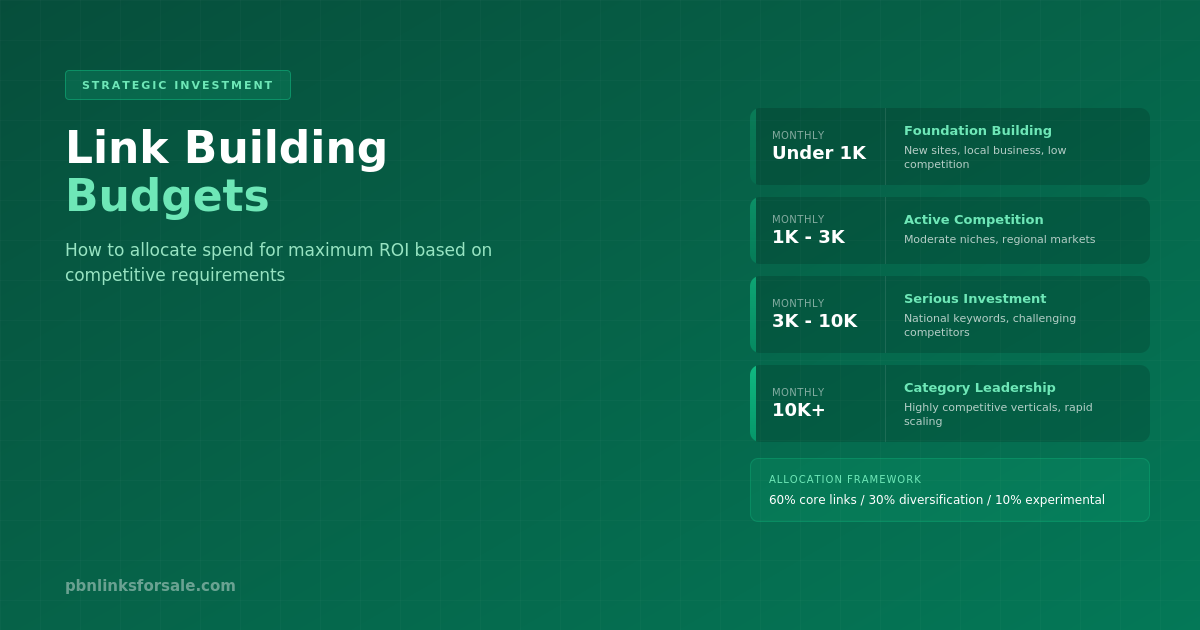
Different budget levels enable different strategies. Understanding what's realistic at each tier helps set appropriate expectations.
At this level, you're building foundation rather than competing aggressively. Expect 5-10 quality links monthly depending on your niche and chosen link types.
This budget works for: new sites establishing initial authority, local businesses with limited geographic competition, niches with low link requirements, or maintaining position in spaces you've already won. Local businesses often need different approaches than national competitors—sometimes modest budgets produce strong results in local search.
This budget doesn't work for: competitive national keywords, saturated niches where leaders have thousands of referring domains, or catching up to established competitors quickly.
At this level, efficiency matters enormously. Focus on link types that deliver the best value per pound. Standard PBN links often provide better cost-efficiency than premium guest posts when budgets are tight.
This range enables actual competitive link building for many niches. Expect 10-25 quality links monthly, with room for mix diversity.
This budget works for: moderately competitive niches, regional rather than national competition, B2B spaces with limited players, or accelerating growth in spaces where you already have a foundation.
At this level, you can diversify across link types. Combine bundled packages that mix different link types with targeted placements for specific pages. The budget supports strategic allocation rather than just buying whatever you can afford.
This budget still doesn't work for: highly competitive e-commerce categories, YMYL spaces dominated by major players, or catching up to competitors with significant head starts in competitive markets.
This tier enables competitive play in most spaces outside the most saturated categories. Expect 25-75+ quality links monthly depending on link type mix and cost efficiency.
This budget works for: competitive national keywords, challenging established players in most industries, multi-page strategies targeting numerous keywords, and rapid authority building.
At this level, allocation strategy matters as much as volume. You have enough budget to make choices: heavy investment in one area versus balanced spread, quality premium versus quantity, speed versus sustainability. These decisions significantly impact outcomes. Some businesses find that balanced cocktail approaches produce better results than concentrating budget in single link types.
This budget may still fall short for: ultra-competitive finance, insurance, gambling, or legal keywords where leaders invest hundreds of thousands in SEO, or spaces dominated by brands with effectively unlimited marketing resources.
At this level, you're playing to win category leadership. Expect 75-200+ quality links monthly with room for premium placements, digital PR, and comprehensive coverage.
This budget enables: competing in highly competitive verticals, building authority across large sites with many pages, aggressive timeline compression, and premium placement strategies.
At this investment level, the focus shifts from volume to strategic comprehensiveness. You can pursue tier-one links that smaller budgets can't access. You can build links to many pages simultaneously rather than sequentially. You can invest in brand-building PR alongside direct link acquisition.
How you split budget across link types often matters more than total spend. Different allocation strategies serve different goals.
A common effective allocation: 60% on core link types that provide reliable ranking impact. 30% on diversifying link types that build profile naturalness. 10% on experimental or premium placements.
For most sites, the 60% core might include a mix of niche edits and guest posts—proven link types with predictable results. The 30% diversification might include blogroll links, citations, and profile links that round out the portfolio. The 10% experimental might test new link sources or pursue premium placements.
This framework provides stability—most of your budget goes to known quantities—while allowing evolution and preventing over-reliance on single link types.
Some businesses benefit from varying link building intensity throughout the year. Seasonal link building strategies align investment with business cycles.
If Q4 drives 50% of your revenue, you might allocate 40% of annual link building budget to Q2-Q3, building authority before the crucial period. The lead time required for SEO results means investing months before you need the rankings.
Conversely, if your business has strong seasonal patterns with genuine off-seasons, reducing link building during slow periods and concentrating budget in pre-peak periods can improve ROI.
Rather than spreading links evenly, concentrate budget on pages with highest revenue potential. A page that could generate £100K annually if it ranked #1 deserves more investment than a page with £5K potential.
Calculate the revenue delta: what's the difference in revenue between your current position and target position? That delta sets the justifiable investment for that page. Spending £20K to improve a page from £10K to £110K annual revenue makes sense. Spending £20K to improve a page from £5K to £7K doesn't.
This analysis often reveals that fewer pages deserve aggressive investment than businesses assume. Concentrating budget on genuinely high-value targets produces better returns than spreading thinly across everything.
Different industries have different link economics. Building links in boring industries requires different approaches than building links in naturally linkable spaces like tech or entertainment.
Some industries benefit from niche-specific link sources. Finance-focused PBN links carry more relevance weight for financial services than general links. Travel and accommodation links matter more for travel businesses. Allocating budget toward niche-relevant sources often produces better results than generic high-authority links.
Link building ROI is real but delayed. Understanding realistic timelines prevents premature abandonment or unrealistic expectations.
Links built today won't produce ranking improvements tomorrow. The typical sequence: links get indexed over 2-4 weeks, Google evaluates their impact over 4-8 weeks, rankings shift gradually over 2-4 months. Total lag from link placement to measurable results: 2-4 months minimum.
This means evaluating link building ROI requires patience. Judging a campaign's effectiveness after one month measures nothing meaningful. Three months shows early signals. Six months provides reasonable evaluation data. Twelve months shows mature results.
Budget accordingly. If you need results in 3 months, start building 6 months before that deadline. Link building isn't a tap you turn on when you need traffic—it's an investment that pays out over time.
Track the revenue attributable to organic traffic improvements. If a page moved from position 8 to position 3, estimate the traffic increase. Apply your conversion rate and average order value. That's the revenue gain from improved ranking.
Compare revenue gain to link building cost over the period. A £5,000 link building investment that produces £15,000 in additional revenue represents 3x ROI. Factor in the ongoing nature of gains—a ranking improvement persists, generating revenue month after month, while the link cost was one-time.
This calculation often reveals that effective link building produces extraordinary long-term ROI. The challenge is the upfront investment period before returns materialise.
Not all link building produces positive ROI. If rankings don't improve despite consistent investment, something's wrong. Possible causes: link quality too low, wrong pages targeted, content issues limiting ranking potential, or simply being outspent by competitors.
Diagnosis matters. Understanding why backlink audits often miss the real issues helps identify whether the problem is link quality, link quantity, or factors beyond links entirely.
Sometimes the answer is that your budget isn't sufficient for your targets. Spending £1,000/month in a space that requires £5,000/month won't produce ROI no matter how efficiently you spend—you're simply below the competitive threshold.
Common budget errors that undermine link building effectiveness:
Starting and stopping. Inconsistent investment produces inconsistent results. Building heavily for three months, then pausing for three months, then resuming creates jagged authority curves that underperform consistent monthly investment. Commit to sustainable budgets you can maintain over time.
Chasing cheap over effective. The cheapest links rarely deliver the best value per pound. Paying £20 for links that produce nothing wastes £20. Paying £200 for links that actually move rankings delivers ROI. Budget for quality, not just quantity.
Ignoring competitive context. Budgeting without competitive analysis leads to either overspending in easy spaces or underspending in competitive ones. Let competitive requirements guide investment levels.
Expecting immediate results. Cutting budget because results haven't appeared after 6 weeks ignores how SEO actually works. Build in evaluation periods that match realistic timelines before making budget decisions.
Not accounting for link decay. Some links will disappear or lose value over time. Budget should include buffer above maintenance level to account for attrition. If you're building exactly what you need to maintain position, you're actually falling behind as old links decay.
Spreading too thin across targets. Building 2 links each to 10 pages often produces worse results than building 20 links to 1 priority page. Concentration of effort produces ranking improvements; dilution produces nothing measurable on any page.
Budgets shouldn't be static. Conditions change, and investment should adjust accordingly.
When current investment is producing positive ROI. If every pound spent on links produces £3 in revenue, the logical response is spending more pounds. Proven ROI justifies increased investment.
When competitors accelerate. If monitoring reveals competitors increasing their link building, you may need to increase yours to maintain relative position. Staying flat while competition grows means falling behind.
When new opportunities emerge. A new product launch, market expansion, or strategic shift may justify temporary budget increases to establish presence quickly in new areas.
When you're close to breakthrough. If you're positioned just below top rankings, a temporary budget surge might push you over the threshold. The returns from ranking #3 versus #8 often justify significant short-term investment.
When you've achieved dominance. If you're ranking #1 with a significant lead over competitors, aggressive link building may be overkill. Shift to maintenance levels that preserve position without overspending.
When ROI turns negative. If extended investment isn't producing results despite troubleshooting, reducing budget while reassessing strategy makes sense. Continuing to fund an ineffective approach wastes resources.
When competitive dynamics change. If competitors exit or reduce their investment, you may not need to maintain previous levels. Conversely, if the SERP shifts away from traditional organic results, reducing investment in that channel may be appropriate.
When business priorities shift. If other marketing channels show better returns, or if business strategy moves away from organic-dependent revenue, budget reallocation makes sense.
Budget allocation decisions are easier with experienced input. Several resources can help:
Competitive analysis tools like Ahrefs, Semrush, and Majestic provide data on competitor link profiles and acquisition rates. This data grounds budget decisions in competitive reality rather than guesswork.
Backlink recommendation tools can help match your situation to appropriate link building approaches. Rather than guessing which link types suit your needs, structured recommendations align options to goals.
Link building providers with consultation services can assess your competitive position and recommend appropriate investment levels. Our dedicated service page offers guidance on approaching link building strategically rather than haphazardly.
Putting this together into a practical process:
Start with competitive analysis. Understand what it actually takes to compete in your space. Don't set budgets based on what feels comfortable—set them based on competitive requirements.
Calculate the ROI math. What's the revenue potential of improved rankings? What investment is justifiable given that potential? Let business outcomes guide investment levels.
Choose an allocation framework. Decide how to split budget across link types, pages, and time periods. Structured allocation outperforms ad hoc spending.
Commit to realistic timelines. Build evaluation periods that match SEO realities. Three-month campaigns rarely produce meaningful data. Plan for six to twelve months minimum.
Monitor and adjust. Track results against expectations. Increase investment when ROI is positive. Adjust allocation when certain approaches outperform others. Scale down when goals are achieved.
Link building budgets aren't expenses to minimise—they're investments to optimise. The right budget produces compounding returns that far exceed cost. The wrong budget wastes resources on efforts that never reach competitive threshold. Strategic budgeting makes the difference between link building that transforms your organic presence and link building that produces nothing measurable.
Whatever your budget level, spend strategically. Understand what you're trying to achieve. Know what it actually requires to achieve it. Allocate resources based on potential returns, not arbitrary numbers. And commit to timelines that allow SEO to actually work.







2025 © Copyrights PBN Links For Sale

Stop struggling with SEO. Our expert team will analyze your website and create a custom backlink strategy that delivers real results. Get more traffic, more leads, and more revenue.
Take the first step towards expanding your business online with our Backlinks services. We work with many private individuals and SEO agencies. We can help you take care of all your Backlink needs and rank your websites correctly. Boost your website's rankings today!


Find the perfect solution for your SEO and link building needs
Browse our full range of quality backlinks and SEO services
Shop NowComplete packages for every budget and ranking goal
View PackagesWhite-label solutions for agencies and resellers
Agency PlansProfessional SEO services at competitive prices
Learn More