I'm about to say something that goes against what most e-commerce site owners believe: you probably shouldn't be building links to your product pages.
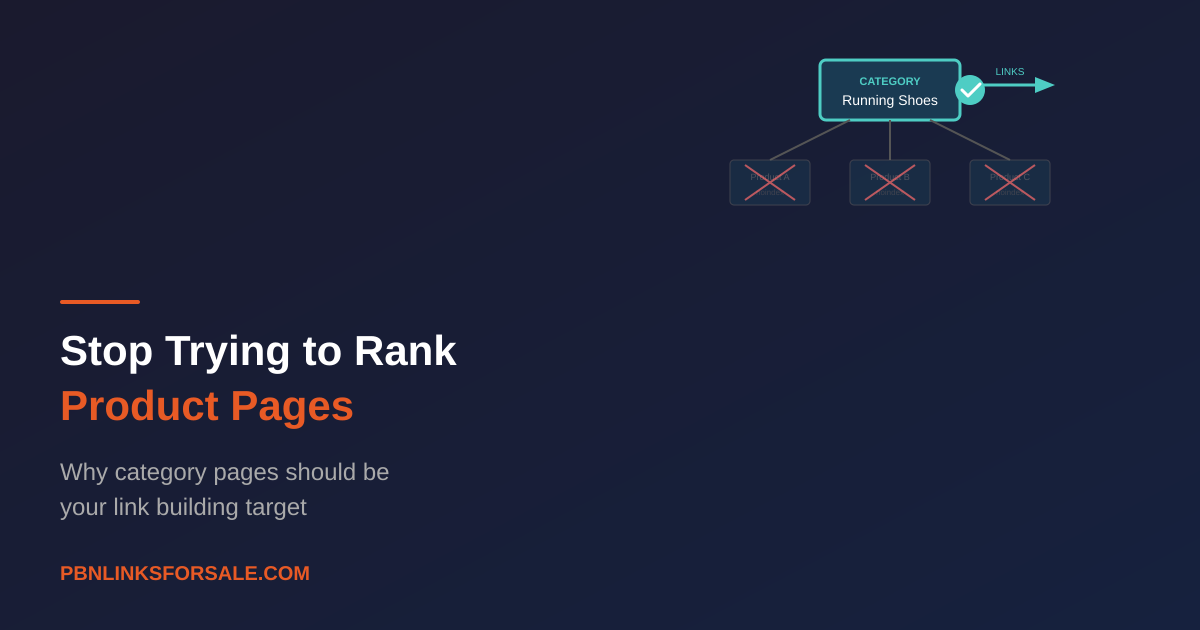
I'm about to say something that goes against what most e-commerce site owners believe: you probably shouldn't be building links to your product pages.


We can assure you, that we only place your backlinks in super high-quality PBN Networks that are both safe and reliable. With a limited amount of selling in each site.

PBNs can be quite tricky, and having been burned in the past I was very apprehensive. But their service happens to be quite safe as my website has not seen any penalties. On the contrary, we’ve seen an increase in rankings.

I must say, quite an affordable service for the quality delivered. The links are well placed and the websites look genuine for the most part. I’ll be back again.
I'm about to say something that goes against what most e-commerce site owners believe: you probably shouldn't be building links to your product pages.
In fact, for most online stores, product pages shouldn't even be in Google's index.
Sounds mental, right? You've got hundreds or thousands of products and you're not supposed to rank them? Bear with me. By the end of this, you'll understand why the smartest e-commerce SEOs focus their link building almost exclusively on category pages—and why doing anything else is usually a waste of resources or actively harmful.
Product pages have several characteristics that make them poor link targets and problematic ranking targets:
They're temporary. Products go out of stock. Products get discontinued. Seasonal items rotate. When you build links to a product page and that product disappears, those links now point to a 404 or a redirect. The equity you built gets diluted or lost entirely.
They compete with each other. If you sell running shoes, you might have 50 different product pages for 50 different shoes. Every one of those pages is theoretically competing for 'running shoes' related queries. Google has to pick which one to show—and often it picks none of them because they're all thin, similar pages cannibalising each other.
They're thin by nature. A product page has a title, some specs, maybe a description, reviews if you're lucky. That's not much for Google to work with. Compare that to a category page that can have substantial introductory content, filtering options, comparison information, buying guides—actual substance.
They don't match search intent. When someone searches 'buy running shoes,' they usually want to see options and compare. A single product page doesn't serve that intent—a category page with multiple products does. Google knows this, which is why category pages tend to outrank product pages for commercial queries.
Category pages solve every problem product pages create.
They're permanent. Your 'Running Shoes' category isn't going anywhere. Individual products within it will come and go, but the category persists. Links you build to category pages retain their value indefinitely because the destination remains stable.
They consolidate authority. Instead of spreading link equity across 50 competing product pages, you concentrate it on one category page. That page becomes genuinely authoritative for the topic, and it can rank for the high-volume head terms that actually drive significant traffic.
They can carry real content. Category pages can include buying guides, comparison charts, educational content about the product type, FAQs—substantial material that demonstrates expertise and gives Google something to evaluate. This makes them far more competitive for valuable keywords.
They match how people search. The highest-volume commercial keywords are usually category-level: 'running shoes,' 'men's watches,' 'wireless headphones.' People search for product types, not specific model numbers. Category pages target the queries that matter most.
Here's where it gets tactical. For many e-commerce sites, the optimal approach is to noindex product pages entirely while keeping them as 'follow.'
What does this mean practically?
Adding a noindex tag tells Google not to include that page in search results. The page still exists, users can still access it, but it won't appear in SERPs and won't compete with your other pages.
Keeping the page as 'follow' means Google will still crawl links on that page. So internal links from your product pages to category pages, to related products, to your homepage—all of that still passes value and helps Google understand your site structure.
The result: your category pages don't have to compete with hundreds of weak product pages for the same keywords. Your crawl budget gets focused on the pages that matter. Your internal link equity flows upward to the pages you're actually trying to rank.
This isn't theoretical. Major e-commerce players have used this approach. It's particularly effective for sites with large product catalogues where product pages are creating massive keyword cannibalisation problems.
Once you accept that category pages are your ranking targets, your entire link building approach shifts.
Target selection becomes clearer. Instead of agonising over which of your 500 products to build links to, you identify your 10-20 most important category pages and focus there. Simpler decisions, concentrated impact.
Anchor text strategy simplifies. Category pages naturally target broader keywords that are easier to build natural-looking anchor text around. 'Running shoes' is a much more natural anchor than a specific product model number.
Content for link acquisition improves. When you're promoting category pages, you can create supporting content about the product type generally—buying guides, comparison content, trend analysis—that's genuinely linkable. Try getting natural links to a single product page. It's nearly impossible unless the product is genuinely newsworthy.
ROI increases. Links to category pages benefit every product within that category. A link to your 'Running Shoes' page helps all 50 products in that category rank better through improved internal linking from a stronger parent page. Links to individual product pages only help that one product.

I'm not saying never build links to product pages. There are exceptions:
Flagship products. If you have a signature product that defines your brand and will remain in your catalogue indefinitely, building links directly to it can make sense. Think of it as a category of one.
Products with unique search demand. Some products get searched by name—specific tech products, designer items, collectibles. If people are actually searching '[exact product name],' ranking the product page for that query makes sense.
Evergreen products. Products that don't go out of stock and don't get discontinued—basic supplies, commodity items—have some of the permanence issues solved already.
But notice: these are exceptions. For the vast majority of products in most e-commerce catalogues, the category-first approach still applies.
Just because you're not building external links to product pages doesn't mean they're unimportant. Product pages play a crucial role in internal linking.
Every product page should link back to its parent category. This passes link equity upward to your ranking targets. If your category page gets external links, that equity flows down to products through your internal linking. If product pages get any organic links (it happens occasionally), that equity flows up to the category.
Product pages should also cross-link to related products—and importantly, to other relevant categories. A running shoe product page might link to 'Running Socks' and 'Running Accessories' categories, spreading relevance signals across your category structure.
Think of product pages as internal link hubs, not external link targets. They serve your users and support your site architecture without needing to rank themselves.
If you're considering this approach for your site:
Audit your current situation first. Check which pages are currently ranking and for what keywords. If individual products are ranking well for valuable terms, don't blindly noindex them. The strategy is about optimising future effort and fixing cannibalisation—not destroying what's already working.
Strengthen category pages before making changes. Make sure your category pages have substantial content, proper structure, and clear internal linking before you start redirecting strategic focus to them.
Consider a phased rollout. Don't noindex 5,000 product pages overnight. Start with categories where cannibalisation is worst, monitor results, then expand.
Get your internal linking right. The noindex approach only works if your internal linking properly connects products to categories. Without that, you're just removing pages from the index without concentrating authority anywhere useful.
This isn't just about link building efficiency. It's about site architecture strategy.
E-commerce sites that try to rank every product page are fighting an impossible battle. They're spreading authority thin, creating cannibalisation nightmares, building links to pages that might not exist next year, and competing against sites that consolidated their strategy properly.
Sites that focus on category pages have cleaner architectures, stronger ranking pages, more efficient link building, and better long-term results. The initial mindset shift feels counterintuitive—'but I want ALL my products to rank!'—but the results speak for themselves.
Build links to category pages. Let your category rankings drive traffic to product discovery. Use your products to support your categories, not compete with them.


2025 © Copyrights PBN Links For Sale

Stop struggling with SEO. Our expert team will analyze your website and create a custom backlink strategy that delivers real results. Get more traffic, more leads, and more revenue.
Take the first step towards expanding your business online with our Backlinks services. We work with many private individuals and SEO agencies. We can help you take care of all your Backlink needs and rank your websites correctly. Boost your website's rankings today!


Find the perfect solution for your SEO and link building needs
Browse our full range of quality backlinks and SEO services
Shop NowComplete packages for every budget and ranking goal
View PackagesWhite-label solutions for agencies and resellers
Agency PlansProfessional SEO services at competitive prices
Learn More