

We can assure you, that we only place your backlinks in super high-quality PBN Networks that are both safe and reliable. With a limited amount of selling in each site.

PBNs can be quite tricky, and having been burned in the past I was very apprehensive. But their service happens to be quite safe as my website has not seen any penalties. On the contrary, we’ve seen an increase in rankings.

I must say, quite an affordable service for the quality delivered. The links are well placed and the websites look genuine for the most part. I’ll be back again.
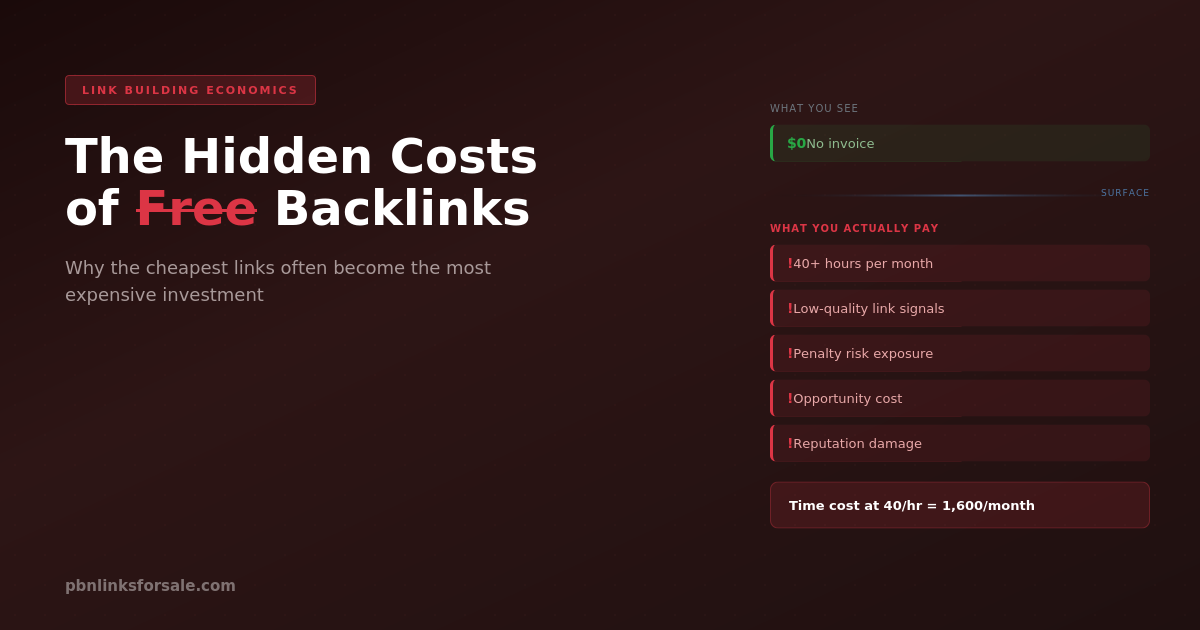
Free is the most expensive word in SEO.
That sounds counterintuitive until you've spent three months building "free" backlinks only to realise you've invested hundreds of hours, acquired links that moved nothing, and potentially created problems that will take even longer to fix. We've watched this cycle play out with countless site owners who came to us after their DIY link building efforts produced disappointing results—or worse, actual damage.
The appeal of free backlinks is obvious. Link building services cost money. Budgets are limited. If you can achieve the same results without spending, why wouldn't you? The logic seems sound until you account for the costs that don't appear on an invoice.
This piece breaks down those hidden costs honestly. Not because free link building methods never work—some do, in specific circumstances. But because the true cost-benefit calculation is far more complex than "free versus paid." Understanding these hidden costs helps you make decisions that actually serve your goals rather than just your budget.
Every hour you spend building free backlinks is an hour you're not spending on something else. This opportunity cost is real even if it never appears in your accounting.
Let's trace a typical "free" link building session. You decide to build some directory links—supposedly quick and easy. First, you need to find directories that are actually worth submitting to. Most directories are garbage that will either reject your submission, never approve it, or provide links so worthless they might as well not exist. Finding legitimate directories takes research time.
Then comes the submission process. Each directory has its own form, its own category structure, its own requirements for descriptions and details. You fill out the same basic information slightly differently a dozen times. Some require account creation. Some require email verification. Some have approval queues that take weeks. You track submissions in a spreadsheet because otherwise you'll lose track of what you've done.
Two hours later, you've submitted to maybe 15-20 directories. Of those, perhaps 10 will actually approve the submission. Of those 10, perhaps 2-3 have enough authority to matter. And even those 2-3 links are low-value compared to contextual editorial links. You've spent two hours to acquire links that will barely register in your backlink profile's effectiveness.
Now multiply this across all the "free" link building tactics. Blog commenting: finding relevant blogs, reading content to leave substantive comments, waiting for moderation, hoping the link isn't nofollowed. Forum participation: joining communities, building reputation before you can include links, contributing value to avoid looking like a spammer. Guest post outreach: researching prospects, crafting pitches, handling rejections, negotiating terms, writing content.
Each tactic that's "free" in monetary terms demands significant time investment. The question becomes: what's your time worth, and what else could you accomplish with it?
If you're a business owner or marketer, your time has calculable value. Maybe you bill clients at a certain rate. Maybe your salary divided by working hours gives you an hourly figure. Maybe there are revenue-generating activities you could pursue instead of link building.
Let's say your time is worth £50 per hour—a conservative figure for many business owners. If "free" link building takes you 10 hours to acquire 5 links that actually matter, you've spent £500 worth of time. Would £500 spent on professional link building have produced better results? In most cases, yes. Significantly better.
This calculation becomes even more stark when you account for expertise. Professional link builders know where to find opportunities, how to evaluate quality quickly, what outreach actually converts. They've made the mistakes already and learned from them. A professional might accomplish in one hour what takes a novice five hours—and produce better results.
Time cost isn't just about the hours spent building links. It's about the learning curve, the trial and error, the inevitable mistakes that need correction. Free link building means paying with time instead of money—and for most people, time is actually the more valuable resource.
Not all backlinks are equal. This is the foundational truth of modern link building. A single high-quality editorial link from a relevant, authoritative site can outperform dozens or hundreds of low-quality links from directories, forums, and blog comments. We covered this extensively in our analysis of link building metrics that actually matter—the short version is that Google evaluates link quality on multiple dimensions, and most free link sources fail on most of them.
Free backlink methods tend to produce links with specific weaknesses:
Low authority sources. Directories, forums, and blog comment sections rarely carry significant authority themselves. They're not sites Google has decided deserve prominent rankings. A link from a site Google doesn't trust doesn't transfer much trust to you.
Poor contextual relevance. A link in a directory listing or forum signature lacks the contextual signals that make editorial links valuable. There's no surrounding content establishing why the link makes sense. Google's systems increasingly evaluate links based on their context—and context-free links carry less weight.
Nofollowed or ignored attributes. Many free link sources automatically apply nofollow, sponsored, or UGC attributes to outbound links. Google has stated these are treated as hints rather than directives—but hints to potentially discount the link. The value proposition diminishes further.
Templated anchor text. Directory listings typically use your business name or URL as anchor text. While brand anchors are part of a healthy profile, exclusive reliance on them means you're not building keyword relevance signals. Anchor text distribution matters, and free methods offer little control over it.
High spam proximity. Free link sources attract everyone trying to build links cheaply—including actual spammers. Your link appears alongside links to gambling sites, pharmaceutical spam, and other low-quality targets. This guilt-by-association can diminish your link's value even if your own content is legitimate.
The quality gap means you might need 50-100 free links to achieve the ranking impact of 5-10 quality paid placements. When you factor in the time required to build those 50-100 links, the "free" option becomes dramatically more expensive than just investing in quality from the start.
Some free link building methods don't just underperform—they actively create problems. The potential for negative impact turns "free" links into a liability that could cost far more than any paid alternative.
Google's webmaster guidelines explicitly prohibit certain link building practices. Participating in link schemes—whether you're paying or not—can result in manual actions that devastate your search visibility.
"Free" link exchanges fall squarely in this territory. "You link to me, I'll link to you" arrangements are explicitly called out as violations. Link wheels and tiered link schemes, even when you're not paying for them, violate guidelines. Participating in blog networks where everyone links to everyone creates detectable patterns that trigger penalties.
The free link might have cost you nothing to acquire. The manual action it contributes to could cost you months of recovery work and significant revenue during the penalty period. That's not a theoretical risk—we've worked with sites that spent over a year recovering from penalties triggered by "free" link building gone wrong.
Even when free links don't trigger manual penalties, they may be algorithmically devalued to the point of uselessness—or worse, counted as negative signals.
Google's algorithms have become sophisticated at identifying link patterns that indicate manipulation. A backlink profile dominated by directory links, forum signatures, and blog comments looks nothing like a natural profile. It looks like someone trying to game the system with whatever free methods they could find. That pattern itself can suppress rankings even if no single link violates guidelines.
The March 2026 spam update reminded everyone that Google continues investing in link spam detection. SpamBrain gets smarter with every iteration. Link sources that worked "free" last year may be completely devalued this year. And unlike paid links from reputable providers, you have no recourse when free link sources get nuked—you just absorb the loss and potentially the collateral damage. We wrote about the real cost of cheap PBN links previously, but the same principles apply to "free" link sources—cheap and free often carry similar risks.
Some free link building methods damage your brand independently of their SEO impact. Spammy blog comments make your business look desperate. Forum posts that exist only to drop links alienate communities you might genuinely want to participate in. Guest posts on low-quality sites associate your brand with garbage content.
People notice these things. Potential customers who encounter your brand in a spammy context form negative impressions. Industry peers see your links in places that signal inexperience or desperation. The reputational cost may be invisible in your analytics but real in opportunities you never receive.
Let's examine the most common free link building methods and their actual cost-benefit profiles.
Time cost: High. Finding legitimate directories, completing submissions, tracking approvals—hours per handful of links.
Quality: Low. Most directories carry minimal authority. Links are non-contextual.
Risk: Moderate. Over-reliance creates unnatural patterns. Many directories are spam traps.
Verdict: A handful of high-quality niche directories may have limited value for local SEO citation purposes. Mass directory submission is a waste of time at best and risky at worst.
Time cost: High. Finding relevant posts, writing substantive comments, waiting for moderation.
Quality: Very low. Comments are typically nofollowed, non-contextual, and carry minimal authority.
Risk: Moderate. Spammy commenting damages reputation. Over-reliance looks manipulative.
Verdict: Genuine community participation has value beyond links, but building comments specifically for links is ineffective. The links themselves rarely move rankings.
Time cost: Very high. Building reputation takes months before link opportunities arise naturally.
Quality: Low to moderate. Signature links are weak. In-context links from established members can have modest value.
Risk: Low if genuine, high if spammy. Communities police themselves aggressively.
Verdict: Legitimate forum participation can generate occasional valuable links and referral traffic. But treating forums primarily as link sources produces neither good links nor community standing.
Time cost: Low to moderate. Creating profiles is quick; maintaining them is ongoing.
Quality: Minimal for direct ranking impact. Social profiles are typically nofollowed and expected.
Risk: Low. These are normal business activities regardless of SEO.
Verdict: Create social profiles because they're useful business infrastructure, not because they build meaningful link authority. Any SEO benefit is incidental.
Time cost: Moderate to high. Creating accounts, building out properties with content, maintaining them.
Quality: Low. Web 2.0 platforms have been devalued repeatedly. Most links from them carry minimal weight.
Risk: Moderate to high. Mass Web 2.0 creation is a known spam signal. Many platforms actively remove promotional content.
Verdict: Once a viable tactic, Web 2.0 link building has been devalued to the point of irrelevance for competitive rankings. The time investment produces minimal return.
Time cost: Moderate. Finding partners, coordinating exchanges, maintaining relationships.
Quality: Potentially decent if partners are relevant and authoritative. Often poor because exchanges attract low-quality participants.
Risk: High. Explicit link exchanges are a violation of Google's guidelines. Patterns are detectable.
Verdict: Avoid. This is a link scheme regardless of whether money changes hands. The risk dramatically outweighs any potential benefit.
Time cost: Very high. Researching targets, pitching, handling rejections, writing full articles, revisions.
Quality: Variable. Sites accepting free contributions range from excellent to worthless.
Risk: Low to moderate depending on site quality. Guest posting on spam sites damages reputation.
Verdict: High-quality guest posting can be valuable—but sites that accept free contributions are often lower quality than those requiring payment. The best publications have standards that make free placement difficult or impossible. When you calculate the hours spent on outreach, writing, and revisions, "free" guest posting often costs more in time than paid placements cost in money.
Despite everything above, there are circumstances where free link building methods have legitimate value. Recognising these situations helps allocate effort appropriately.
When you genuinely have no budget. If you're bootstrapping a business with literally zero marketing budget, imperfect action beats inaction. Building some free links while you establish revenue is better than building none. Just recognise you're making a trade-off and plan to upgrade your approach when resources allow.
When the activity has value beyond links. Genuine forum participation in your industry builds relationships, establishes expertise, and generates referral traffic. Guest posting on quality sites builds brand visibility and thought leadership. These activities produce value even if the links were worthless. When links are a bonus rather than the purpose, the calculation changes.
When you have excess time and limited money. A student building a side project, a retiree pursuing a hobby site, someone in early career with more hours than income—these situations may favour time investment over financial investment. The key is being realistic about what that time produces versus what money could produce.
When targeting highly specific niche opportunities. Sometimes your industry has specific communities, directories, or platforms where presence matters and costs nothing. Industry association directories, niche forum communities, specialised resource lists—these may be genuinely valuable and free. But these opportunities are narrow, not a general link building strategy.
When building foundational profile diversity. A handful of social profiles, legitimate business directories, and industry citations help establish baseline presence. These shouldn't be your primary link building strategy, but having them creates normal-looking profile foundations that support more aggressive tactics.
Let's make this concrete with numbers.
Assume you value your time at £40/hour—below what many business owners bill. You spend 10 hours per week on "free" link building. Over a month, that's 40 hours, or £1,600 worth of time.
Those 40 hours of free link building might produce 20-30 links of varying (mostly low) quality. Perhaps 5-10 of those links have any real value. The rest are noise.
That same £1,600 spent on professional link building could produce 8-15 high-quality placements—guest posts on real sites with real traffic, niche edits on established articles, PBN links from quality networks. Each of these individual links likely carries more ranking impact than all 20-30 of your free links combined.
And those 40 hours you would have spent building free links? You could use them to create content that attracts links naturally. Or improve your site's conversion rate. Or serve customers. Or pursue any other activity that generates revenue rather than consuming time on low-value tasks.
The math works against free link building in almost every realistic scenario. The only way it favours free methods is if your time has literally zero alternative value—and if that's true, you have bigger problems than link building.
The most effective link building strategies aren't purely free or purely paid. They allocate resources strategically based on what produces the best returns.
Pay for the foundation. High-quality contextual links from authoritative, relevant sites are the backbone of any serious link profile. These are difficult to acquire for free and relatively straightforward to acquire through paid placements or professional services. Invest money where money produces results. A balanced link building package can establish this foundation efficiently.
Use time for relationship building. Genuine community participation, industry networking, and relationship development can't be bought. Invest time in activities that build authentic connections with people who might link to you because they genuinely value your work—not because you asked or paid.
Create link-worthy content. Instead of spending time building low-quality links, invest that time in creating content valuable enough to attract links naturally. Original research, comprehensive guides, useful tools, thought leadership—these assets attract links without manual building and compound in value over time.
Handle easy wins yourself. Claiming your business on legitimate directories, setting up social profiles, fixing unlinked brand mentions—these quick tasks make sense as DIY activities. They're foundational rather than strategic.
Outsource the heavy lifting. Professional link building services have economies of scale, established relationships, and expertise you'd take years to develop. Whether working with an agency relationship or individual purchases, outsourcing link acquisition often produces better results per pound than DIY efforts.
Free backlinks aren't free. They cost time. They often cost quality. They sometimes cost rankings and reputation. The hidden costs accumulate invisibly until you wonder why your link building efforts haven't produced results.
This isn't an argument that you should pay for every link. It's an argument for honest accounting. When evaluating link building approaches, calculate the true cost—including your time, including the quality differential, including the risk factors.
For most businesses with limited time and serious growth goals, investing money in quality link building produces better ROI than investing time in free methods. The exception is when you genuinely have more time than money, or when the activity produces value beyond the links themselves.
The most expensive links are often the ones that seemed cheapest. Three months of wasted effort. Rankings that never improved. A backlink profile polluted with garbage that takes even longer to clean up. A penalty that costs far more to recover from than quality links would have cost to acquire.
Free is a price that rarely reflects value. Whether you build links yourself, work with professional link building services, or combine approaches—make decisions based on what actually produces results, not what appears to cost least. Your rankings depend on the quality of links, not the price you paid or didn't pay for them.
Calculate honestly. Invest wisely. And remember that in link building, as in most things, you get what you pay for—one way or another.





2025 © Copyrights PBN Links For Sale

Stop struggling with SEO. Our expert team will analyze your website and create a custom backlink strategy that delivers real results. Get more traffic, more leads, and more revenue.
Take the first step towards expanding your business online with our Backlinks services. We work with many private individuals and SEO agencies. We can help you take care of all your Backlink needs and rank your websites correctly. Boost your website's rankings today!


Find the perfect solution for your SEO and link building needs
Browse our full range of quality backlinks and SEO services
Shop NowComplete packages for every budget and ranking goal
View PackagesWhite-label solutions for agencies and resellers
Agency PlansProfessional SEO services at competitive prices
Learn More