

We can assure you, that we only place your backlinks in super high-quality PBN Networks that are both safe and reliable. With a limited amount of selling in each site.

PBNs can be quite tricky, and having been burned in the past I was very apprehensive. But their service happens to be quite safe as my website has not seen any penalties. On the contrary, we’ve seen an increase in rankings.

I must say, quite an affordable service for the quality delivered. The links are well placed and the websites look genuine for the most part. I’ll be back again.
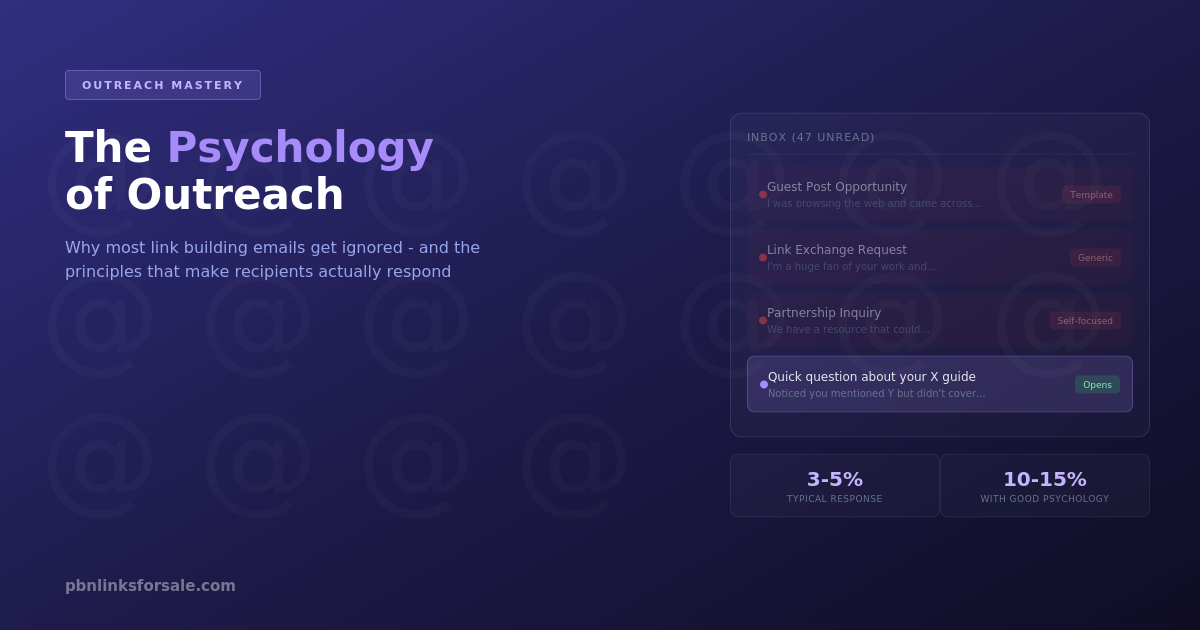
The average website owner or blogger receives dozens of link building pitches every week. Most get deleted without being read. Many get marked as spam. A tiny fraction get responses—and an even tinier fraction result in actual links.
If your outreach isn't working, the problem probably isn't your link building strategy. It's your emails. More specifically, it's a failure to understand the psychology of the person receiving them.
This guide covers why most outreach fails, what recipients actually think when they see your email, and how to craft messages that get responses instead of getting ignored. The principles apply whether you're pitching guest posts, requesting link insertions, or building relationships for future collaboration.
Before examining tactics, understand what you're up against.
Anyone running a website with decent authority receives constant outreach. Not just link requests—PR pitches, partnership proposals, sponsorship inquiries, and various scams. Your email arrives in an inbox already overwhelmed with requests for attention.
Recipients develop pattern recognition. They can identify a link building email within seconds of opening it—sometimes from the subject line alone. Once categorised as "another pitch," your email faces an uphill battle for attention.
The volume creates cynicism. Recipients have seen every template, every fake compliment, every manipulative tactic. They're predisposed to distrust outreach because most outreach they receive is low-effort garbage.
Most outreach asks for something valuable (a link, editorial attention, time) while offering little in return. The recipient bears the cost—reviewing your content, making edits, potentially damaging their site's credibility with low-quality links. You get the benefit.
This asymmetry shapes recipient psychology. They're being asked to do work for your benefit. Unless you make clear what's in it for them, their natural response is to decline or ignore.
Most outreach comes from strangers. The recipient has no relationship with you, no reason to trust your claims, and no obligation to help. You're asking them to take your word that your content is good, your site is legitimate, and your intentions are honest.
Past experience has taught them that most such claims are exaggerated or false. The "high-quality content" turns out to be mediocre. The "relevant resource" turns out to be thinly veiled promotion. This history of disappointment makes recipients skeptical of new promises.
Understanding common failures helps you avoid them.
"I was browsing the web and came across your article about [TOPIC]. I noticed you mentioned [THING] and thought you might be interested in a resource we created..."
Recipients recognise templates instantly. The tell-tale signs: generic compliments that could apply to any site, awkward mail merge fields, structures identical to dozens of other pitches they've received. Template recognition triggers immediate dismissal.
The problem isn't using templates—it's using obvious templates. Every outreach operation needs some standardisation for scale. The failure is not disguising that standardisation with genuine personalisation.
"I'm a huge fan of your work!" "I've been following your blog for years!" "Your article on X really resonated with me!"
These claims are almost always false, and recipients know it. If you were actually a huge fan, you'd demonstrate it with specifics. Generic enthusiasm signals that you're saying whatever you think will work—destroying credibility before you've even made your ask.
False familiarity is worse than no familiarity. Starting cold but honest ("I came across your site while researching X") is more trustworthy than fake enthusiasm.
Pitching content that doesn't match the recipient's site signals that you haven't done basic research. If they write about gardening and you're pitching cryptocurrency content, you've demonstrated you're spraying messages indiscriminately.
This is a prospecting problem as much as an outreach problem. Building a good list of relevant targets prevents irrelevant pitches from ever being sent.
"I wanted to reach out because we have a new article that could get some great exposure on your site." "We're looking to build links and thought your site would be perfect."
These framings centre your needs, not the recipient's. You've explicitly told them the email is about what you want. Why would they care? What's in it for them?
Every outreach email should answer "why should I care?" from the recipient's perspective. If you can't articulate their benefit, you haven't thought through why they should respond.
Long emails don't get read. Recipients skim at best, looking for reasons to delete. If they can't understand what you want within 10 seconds, they're gone.
Every paragraph is a potential exit point. Long backstories, detailed explanations, multiple asks—all create friction that leads to abandonment. The email should be as short as possible while still being complete.
Understanding human psychology helps craft more effective outreach.
People feel obligated to return favours. If you've given something first, they're more likely to give something back. In outreach, this means leading with value rather than leading with asks.
Share something useful before requesting anything. Point out a broken link on their site. Offer a genuine compliment with specifics that prove you've read their work. Provide information they might find valuable. The favour doesn't need to be large—small gestures trigger reciprocity too.
People look to others for guidance on how to behave. If other respected people have done something, it must be acceptable. Demonstrating that others have linked to your content, published your guest posts, or collaborated with you reduces perceived risk.
"This guide has been featured on [respected site]" or "I've previously contributed to [known publication]" provides social proof that you're legitimate. It signals that someone else has vetted you already.
Specific claims are more believable than general ones. "Your article helped me understand the difference between X and Y" is more credible than "I loved your article." Specificity proves you've actually engaged with their work.
Apply specificity throughout: specific references to their content, specific descriptions of what you're offering, specific reasons why the fit makes sense. Vagueness triggers skepticism; specificity builds trust.
People take the path of least resistance. Make it easy to say yes and hard to say no. Reduce the effort required to evaluate your pitch. Minimise the steps between reading your email and taking action.
Include direct links to the content you're pitching. Suggest exactly where a link might fit in their article. Offer to write any needed content yourself. Every obstacle you remove increases response likelihood.
People value things more when they're limited. If your offer is available to everyone forever, there's no reason to act now. If it's limited, decision-making accelerates.
This must be genuine—fake scarcity is obvious and damaging. But if you legitimately have limited capacity ("I can only write three guest posts this month") or time-sensitive offers ("This data will be outdated after X"), communicating that appropriately motivates faster response.
Apply these principles to the actual structure of your outreach.
The subject line determines whether your email gets opened at all. Generic subjects like "Guest post opportunity" or "Link request" signal exactly what the email is—making it easy to delete without opening.
Effective subject lines are specific, intriguing, and avoid obvious outreach markers. Reference their content: "Question about your [specific article topic]." Be direct: "Quick request about [specific page]." Create curiosity without being clickbait.
Test different subject line approaches. Track open rates if your tools allow. Small improvements in subject lines compound across thousands of emails.
The first line should hook attention or get deleted. Don't waste it on pleasantries. "I hope this email finds you well" is a signal that you have nothing interesting to say.
Lead with something relevant to them—a specific observation about their site, a genuine question, a piece of useful information. The opening should demonstrate that this email was written for them specifically, not mass-blasted to thousands.
What's in it for them? This must be clear, specific, and genuinely valuable. "Your readers would find this useful" is weak. "This fills the gap in your guide where you mention X but don't explain how to do it" is strong.
The value can take many forms: content that improves their article, information their audience wants, a resource that makes them look knowledgeable, a relationship that benefits them long-term. But it must be real value, not marketing-speak disguised as value.
Make your request clear and simple. Don't bury it in qualifications or soften it into invisibility. State exactly what you want: "Would you consider adding a link to our guide in your section about X?"
One ask per email. Multiple requests ("You could link to this, or maybe write about us, or perhaps share on social media...") dilute focus and reduce response rates. Pick your primary goal and ask for that alone.
End with a clear next step. "Let me know if you'd like me to send the article" gives them something concrete to respond to. "Looking forward to hearing from you" leaves the ball vaguely in their court.
Keep signatures simple. Long signatures with multiple links, social media icons, and company slogans look promotional and add length without value. Your name, title if relevant, and one contact method are sufficient.
Not all personalisation is equal. Some efforts show genuine research. Others are transparent attempts to fake familiarity.
These demonstrate you've actually engaged with their work:
Specific references to content: "Your explanation of [specific concept] was particularly clear" shows you read carefully.
Connection to recent work: "I noticed your recent article on X—this relates to the point you made about Y" demonstrates current attention.
Identification of genuine gaps: "Your guide covers A and C but doesn't address B—we have content that could fill that" shows analytical engagement.
Awareness of their preferences: Noting their typical content length, style, or focus areas shows you understand what they publish.
These are easily scraped and don't prove anything:
Using their name: "Hi [First Name]" is expected and meaningless as personalisation.
Mentioning their site name: "I love [Site Name]" can be pulled automatically and proves nothing.
Generic article references: "Your article about [Post Title]" without specific content reference shows minimal effort.
Focus personalisation effort on elements that require actual engagement—reading content, understanding their niche, identifying specific opportunities. These are harder to fake and therefore more valuable.
Most responses come from follow-up emails, not initial outreach. People are busy. Emails get buried. Follow-up brings your message back to attention.
Wait 5-7 days before first follow-up. This gives recipients time to see and consider your initial email while keeping you recent enough to remember.
One to two follow-ups is appropriate. Beyond that, you're pestering. If three emails generate no response, they're not interested—further contact damages your reputation.
Follow-ups shouldn't just repeat the original email. Add something new: additional value, new angle, simplified ask. "Just checking if you saw my previous email" adds nothing and feels like nagging.
Keep follow-ups shorter than originals. They can reference the first email briefly and add a new reason to respond. The goal is a gentle reminder with added incentive, not repetition.
There are two fundamentally different approaches to outreach, each with different psychology.
One-time exchanges: you ask for something, they give it (or don't), the relationship ends. This is how most link building outreach operates. It works through volume—enough attempts produce some successes.
Transactional outreach is efficient but limited. Each opportunity requires new effort. There's no compounding benefit from past success. For many situations, buying links directly through guest post services may be more efficient than repeated transactional outreach to cold targets.
Building ongoing relationships with people who can provide repeated value. This requires more upfront investment but compounds over time. A relationship with a respected blogger can yield multiple links, introductions, and opportunities over years.
Relationship building changes outreach psychology. You're not asking for immediate transactions—you're initiating conversations that might lead to future collaboration. The approach is slower, more genuine, and longer-term focused.
Most effective link builders use both: transactional outreach for volume, relationship building for high-value targets who can provide ongoing benefit.
Sometimes outreach isn't the right approach:
When targets are too large. Major publications rarely respond to cold outreach. They have PR contacts and established contributor relationships. Cold email gets filtered before reaching anyone who matters.
When time investment doesn't justify potential return. If prospects have low authority and uncertain response rates, the hours spent on outreach might produce more value spent elsewhere.
When established channels exist. If you can buy the placement directly, hire an agency with relationships, or access the target through other means, outreach may be the hard way to reach an available destination.
Outreach is one tool among many. It works well for mid-tier targets where personalised contact can make a difference. It's often inefficient for either extreme—very high targets who don't read cold email, or very low targets where any individual link isn't worth the effort.
Outreach improves through systematic testing, not guesswork.
Track key metrics: open rates (subject line effectiveness), response rates (email body effectiveness), and conversion rates (overall success). Compare across different approaches to identify what works.
Test one variable at a time. Different subject lines with same body. Different openings with same ask. Different follow-up timing. Controlled testing reveals what actually improves results versus what feels like it should.
Listen to feedback. When recipients do respond—even negatively—their reactions reveal how your outreach is perceived. "I get emails like this every day" tells you something different than "This didn't seem relevant to my site."
Accept that most outreach won't work. Even excellent emails have single-digit response rates to cold targets. The goal isn't 100% response rates—it's incrementally improving on industry averages while maintaining volume.
Outreach psychology ultimately comes down to empathy. Understanding what recipients experience, what they value, and what they're sick of receiving helps you craft messages that stand out from the flood. Your email arrives in a crowded inbox competing against dozens of similar requests. Make it worth reading, and some people will read it. Make it worth responding to, and some will respond.




2025 © Copyrights PBN Links For Sale

Stop struggling with SEO. Our expert team will analyze your website and create a custom backlink strategy that delivers real results. Get more traffic, more leads, and more revenue.
Take the first step towards expanding your business online with our Backlinks services. We work with many private individuals and SEO agencies. We can help you take care of all your Backlink needs and rank your websites correctly. Boost your website's rankings today!


Find the perfect solution for your SEO and link building needs
Browse our full range of quality backlinks and SEO services
Shop NowComplete packages for every budget and ranking goal
View PackagesWhite-label solutions for agencies and resellers
Agency PlansProfessional SEO services at competitive prices
Learn More