

We can assure you, that we only place your backlinks in super high-quality PBN Networks that are both safe and reliable. With a limited amount of selling in each site.

PBNs can be quite tricky, and having been burned in the past I was very apprehensive. But their service happens to be quite safe as my website has not seen any penalties. On the contrary, we’ve seen an increase in rankings.

I must say, quite an affordable service for the quality delivered. The links are well placed and the websites look genuine for the most part. I’ll be back again.
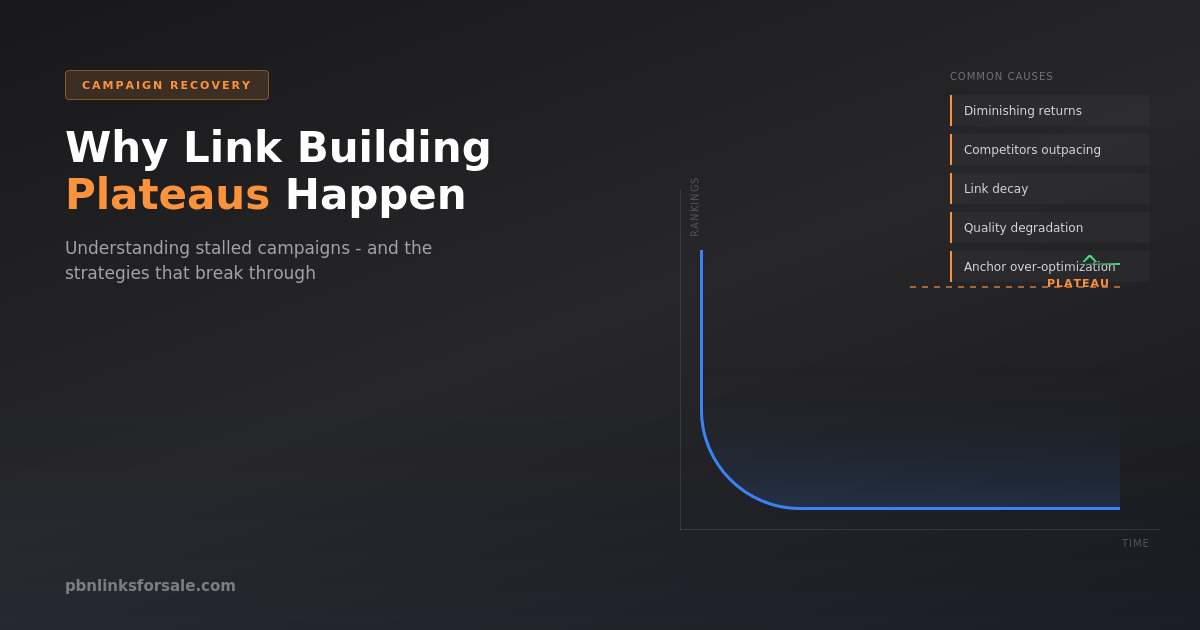
The first few months felt like progress. Rankings climbed. Traffic increased. The link building investment seemed to be paying off. Then somewhere around month six or eight, everything stalled. Rankings stopped improving. Some even slipped. The same activities that produced results earlier now seem to move nothing.
Welcome to the plateau—the frustrating phase where link building efforts continue but results don't. It's one of the most common experiences in SEO, yet it catches most people off guard. They assume something broke. They blame the agency. They wonder if link building "stopped working."
Usually, nothing broke. Plateaus are a predictable feature of link building dynamics, not a bug. Understanding why they happen—and what to do about them—separates campaigns that eventually succeed from those that get abandoned prematurely.
Plateaus emerge from the interaction of several forces. Usually multiple factors contribute simultaneously.
The first links to a page produce the most impact. Moving from zero backlinks to ten creates dramatic ranking improvements. Moving from 100 backlinks to 110 barely registers.
This diminishing returns curve is fundamental to how link authority works. We've covered the compounding effect of link building before—the good news is that benefits compound over time. The complication is that each individual link contributes less as your total grows.
If you've been building links consistently for months, you've captured the easy gains. The links that dramatically improved rankings from position 30 to position 12 worked precisely because you were starting from a weak baseline. Improving from position 12 to position 8 requires more links—and improving from position 8 to position 3 requires even more.
This creates the illusion of plateau when you're actually still making progress—it just takes more links to produce visible movement at higher ranking positions.
You're not building links in isolation. Competitors are building too. If they're building faster than you, your relative position deteriorates even as your absolute link count grows.
This is particularly common when you start showing results. Success attracts attention. Competitors notice you climbing. They respond by increasing their own link building investment. What worked to close the gap now merely maintains it—or worse, fails to keep pace with accelerating competitive activity.
The competitive dimension makes reverse engineering competitor backlinks essential to plateau diagnosis. If competitors are adding 50 quality links monthly while you add 20, your plateau isn't about your strategy failing—it's about being outpaced.
Links disappear. Sites go offline. Content gets deleted. Publishers remove old posts. Even links that remain technically live can lose value as linking domains decline in authority or get penalised. This link decay is ongoing and often invisible.
If you're building 15 links per month but losing 10 to decay, your net gain is only 5. At some point, decay catches up to acquisition. You're running on a treadmill—building links as fast as you're losing them—without any net progress.
Older campaigns are particularly vulnerable. Links from three years ago may have lost significant value or disappeared entirely. The historical links that established your current position are degrading while you focus on new acquisition.
Google's algorithms constantly evolve. Links that carried weight last year may count for less this year. Entire link types or acquisition methods can be devalued in algorithm updates.
The March 2026 updates reminded everyone that Google continues refining how it evaluates links. Sites that relied heavily on specific link types—especially those that looked manipulative—saw values shift. What appeared to be a solid link profile suddenly produced less ranking power.
This creates plateaus that feel sudden and inexplicable. Your link building activity stayed consistent, but results dropped. Nothing changed on your end—the algorithms changed how they valued what you built.
Many campaigns start with high-quality link acquisition and gradually slide toward lower quality. Early enthusiasm brings careful site vetting. Later fatigue brings acceptance of marginal placements.
Agencies experience this too. Initial campaigns for a new client get senior attention. Mature accounts get handed to junior team members or automated systems. Quality drops imperceptibly until it's no longer producing results.
The metrics that indicate link quality might look similar on paper, but traffic, relevance, and actual authority can decline while Domain Rating stays stable. The numbers look okay while the effectiveness erodes.
Sometimes the plateau isn't about links at all—it's about what the links point to. Content becomes outdated. Competitors publish better resources. User behaviour signals deteriorate as searchers find your page less satisfying than alternatives.
Links can only do so much. If the page they point to doesn't satisfy search intent as well as competing pages, no amount of link building overcomes that content deficit. Google balances link signals with quality and relevance signals—and links can't fully compensate for weaknesses elsewhere.
Different causes require different solutions. Before implementing fixes, identify which factors are actually causing your stall.
Pull backlink data for your top 5 competitors ranking above you. Compare: How many referring domains do they have versus you? What's their acquisition rate been over the past 6 months versus yours? What quality tier are their new links?
If competitors have significantly more links, or are building significantly faster, the plateau diagnosis is straightforward: you're being outpaced. The solution involves increasing volume, improving quality, or both.
If you're roughly even with competitors on link metrics but still plateaued, look elsewhere. The problem isn't link volume relative to competition.
Track your historical links. How many from 12 months ago still exist and pass value? How many from 24 months ago? Calculate your decay rate.
If you're losing 20% of links annually (not uncommon), you need to build at least 20% above maintenance just to stay even. A 10-link monthly campaign actually delivers only 8 net links after decay. Over time, this compounds into significant erosion.
High decay rates may also indicate link quality issues. Stable, authoritative sites keep content online longer. Sites that frequently remove content or go offline are often lower quality—and their removal may not be pure loss.
Categorise your recent links by actual quality, not just reported metrics. Pull organic traffic data for linking domains. Check topical relevance. Evaluate link quality properly, not just by Domain Authority.
Compare quality distribution from the first quarter of your campaign to the most recent quarter. If early links were consistently high-quality and recent links skew lower, quality degradation is contributing to your plateau.
Examine your anchor text distribution. Is it natural-looking or over-optimised? Have you built too many exact-match anchors chasing specific keywords? Anchor text ratios matter—unnatural patterns can trigger algorithmic filters that suppress rankings regardless of link volume.
If your exact-match anchor percentage exceeds what competitors show, or looks unnatural compared to organic anchor patterns, over-optimisation may be capping your rankings. Additional links with similar anchors will actually make things worse, not better.
Compare your target page to what ranks above you. Is your content genuinely better, worse, or comparable? Has competitor content been updated while yours stayed static? Does your page satisfy search intent as well as alternatives?
If your content has fallen behind, link building hits a ceiling determined by content quality. You might have enough links to rank first among comparable content—but if competitor content is simply better, links can't fully bridge that gap.
Once you've diagnosed the cause, implement appropriate solutions. Different plateaus require different approaches.
If competitors are simply outbuilding you, the math is clear: build more or accept lower rankings. There's no strategic workaround for being outspent if the competition is also building quality links.
Scaling up might mean increasing budget. It might mean finding more efficient link sources that deliver more value per pound. It might mean diversifying your link building mix to include link types you weren't previously using.
Consider whether you're competing in the right arena. If the top 3 positions require investment levels beyond your capacity, perhaps targeting different keywords—where you can actually win—produces better returns than fighting a losing battle for premium terms.
High decay rates indicate link quality issues. Links from marginal sites disappear faster. Links from established, stable sites persist.
Shift emphasis toward link permanence, not just initial metrics. A DA 40 link from a site that's been operating for 10 years and maintains consistent organic traffic will likely outlast a DA 55 link from a site that's only existed for 18 months.
Accepting that some links will decay means building buffer into your acquisition targets. If 15% of links decay annually, plan for that attrition in your monthly goals. Building 20 links monthly to net 17 after expected decay is realistic planning, not pessimism.
If quality has slipped over time, institute stricter vetting. Require organic traffic minimums for linking domains. Demand topical relevance matching. Reject placements that would have passed before but shouldn't have.
This might mean building fewer links with the same budget. That's okay. Twenty high-quality links will outperform forty mediocre ones. The plateau came from accumulating links that looked good on paper but didn't actually move rankings. Breaking through requires links that actually work.
If you're working with an agency or provider, have direct conversations about quality standards. Show them the analysis demonstrating recent links are weaker than historical ones. Good providers will adjust; bad ones will make excuses.
If anchor text over-optimisation is suppressing rankings, stop building exact-match anchors immediately. Shift to branded anchors, naked URLs, and generic phrases until your profile looks natural.
This rebalancing takes time. You can't un-build the over-optimised links already pointing to you. But diluting them with natural anchors eventually normalises your profile. Plan for 6-12 months of anchor text rehabilitation before expecting the ceiling to lift.
During this period, you're essentially building links to fix a problem rather than to improve rankings. That's frustrating but necessary. The alternative is continuing to hit the same ceiling indefinitely.
If the target page is the problem, no amount of link building solves it. Stop building links temporarily. Invest those resources in content improvement.
Update outdated information. Expand thin sections. Add formats competitors include that you don't—videos, tools, downloadable resources. Address the specific ways competitor content outperforms yours.
Once the page genuinely deserves to rank higher, resume link building. The combination of improved content and additional links often produces breakthroughs that neither alone could achieve.
Beyond addressing root causes, specific tactical changes can restart momentum.
If you've been building primarily one type of link—say, guest posts—adding different types can produce movement. Google's algorithms may respond differently to link diversity than to additional links of the same type.
Add niche edits if you've been doing only guest posts. Include homepage PBN links if you've been relying solely on outreach-based links. The diversity creates a more natural-looking profile and may trigger different algorithmic responses.
If one page is stubbornly stuck, redirect link building to different pages that support the same goal. Build links to related content that internally links to your target. Strengthen category pages that pass authority downward.
Sometimes direct links to a stuck page face diminishing returns while links elsewhere on the site produce fresh gains. The overall domain authority increase eventually benefits all pages—including the one that was plateaued.
If your link building has been consistently mid-tier, pursuing a few genuinely exceptional links can produce breakthroughs. One link from a major publication or highly authoritative site can move rankings more than twenty links from moderate sites.
These tier-one links are harder to acquire and often more expensive. But at plateau, when standard efforts produce nothing, investing in exceptional links may be what's required to break through.
Digital PR, premium press releases, and industry-leading guest posts represent tier-one opportunities. They're not for regular monthly building, but for strategic breakthrough efforts.
If your primary keyword is stubbornly resistant, shift focus to related keywords where you can actually rank. Build links to pages targeting those adjacent terms. Generate traffic and engagement signals that support overall domain authority.
Success on adjacent keywords sometimes triggers movement on the primary term you couldn't crack directly. The rising tide of site authority lifts all pages—including the one that was stuck.
Sometimes plateaus aren't solvable problems—they're phases to wait out. Algorithm adjustments need time to propagate. New links need time to be indexed and evaluated. Changes to strategy need time to accumulate enough signal to matter.
The danger is abandoning effective approaches because results aren't immediate. If your diagnosis shows no obvious problems—you're building quality links at competitive rates with natural anchors to strong content—the plateau may simply be the natural settling period before the next jump.
Rankings often move in steps rather than smooth curves. Months of plateau followed by sudden jumps are normal. The plateau feels like failure but may actually be accumulation before breakthrough.
That said, patience without diagnosis is just hoping. Verify that your approach is fundamentally sound before committing to wait it out. Patience for a good strategy makes sense. Patience for a flawed strategy just delays addressing the real problem.
Sometimes plateaus indicate you've taken an approach as far as it can go. The breakthrough requires not tactical adjustment but strategic rethinking.
When the competitive gap is unbridgeable. If leaders have thousands more referring domains and you can't realistically close that gap, competing on their terms may be futile. Consider pivoting to keywords where you can actually win, or building a differentiated strategy that doesn't require link parity.
When the keyword doesn't justify the investment. ROI matters. If breaking through would require £50K in additional link building for a keyword that generates £30K annually in revenue, the math doesn't work. Redirect resources to more profitable targets.
When the page can't be fixed. Sometimes content limitations are structural. A product page can only be so good. A local business can only be so relevant for national terms. If the page has inherent limitations that prevent it from competing, continuing to build links to it wastes resources.
When the SERP format has changed. Google increasingly inserts features that reduce organic clicks—featured snippets, AI overviews, knowledge panels. If the SERP for your target keyword no longer rewards organic ranking the way it once did, perhaps that keyword isn't worth the investment regardless of whether you can rank for it.
Putting this together into a systematic approach:
First, diagnose. Don't assume you know the cause. Run competitive analysis, decay audits, quality assessments, anchor text reviews, and content comparisons. Identify which factors are actually contributing to your plateau.
Second, address root causes. Fix the underlying issues identified in diagnosis. Scale up if outpaced. Improve quality if degraded. Rebalance anchors if over-optimised. Update content if outdated.
Third, implement tactical changes. While addressing root causes, add tactical variety. New link types, different target pages, tier-one links, adjacent keywords. These changes can produce movement while fundamental fixes take effect.
Fourth, allow time. Changes need time to compound and propagate. Set a reasonable evaluation period—typically 3-6 months—before concluding that adjustments haven't worked.
Fifth, reassess. If changes haven't produced breakthrough after sufficient time, evaluate whether strategic pivot is necessary. Sometimes the right answer is to abandon a losing battle and redirect resources to more winnable fights.
Plateaus are frustrating but normal. Every significant site has experienced them. The difference between those that eventually break through and those that abandon SEO is systematic diagnosis and appropriate response—not just working harder at whatever wasn't working. Whether you're handling this yourself or working with link building partners, understanding plateau dynamics helps you make better decisions about where to invest and when to adjust.






2025 © Copyrights PBN Links For Sale

Stop struggling with SEO. Our expert team will analyze your website and create a custom backlink strategy that delivers real results. Get more traffic, more leads, and more revenue.
Take the first step towards expanding your business online with our Backlinks services. We work with many private individuals and SEO agencies. We can help you take care of all your Backlink needs and rank your websites correctly. Boost your website's rankings today!


Find the perfect solution for your SEO and link building needs
Browse our full range of quality backlinks and SEO services
Shop NowComplete packages for every budget and ranking goal
View PackagesWhite-label solutions for agencies and resellers
Agency PlansProfessional SEO services at competitive prices
Learn More