

We can assure you, that we only place your backlinks in super high-quality PBN Networks that are both safe and reliable. With a limited amount of selling in each site.

PBNs can be quite tricky, and having been burned in the past I was very apprehensive. But their service happens to be quite safe as my website has not seen any penalties. On the contrary, we’ve seen an increase in rankings.

I must say, quite an affordable service for the quality delivered. The links are well placed and the websites look genuine for the most part. I’ll be back again.
March 2026 delivered back-to-back algorithm updates that have reshaped the search landscape. Within a span of just three days, Google released both a spam update and a core update—creating overlapping volatility that has made diagnosis and response more complex than any single update would.
This guide provides a complete breakdown of both updates: confirmed timelines, measured impacts, what the data shows about who won and lost, and actionable guidance for site owners assessing their own situations. Whether you're diagnosing a traffic drop, trying to understand why competitors suddenly moved, or planning your link building strategy going forward, this analysis covers what you need to know.
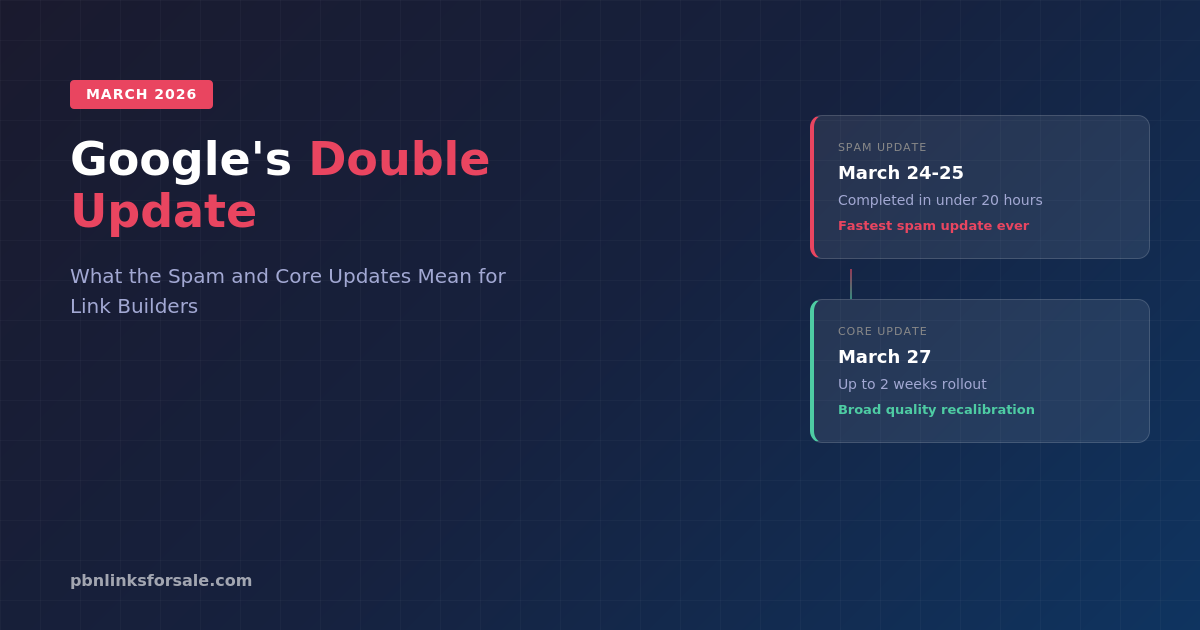
March 2026 Spam UpdateLaunched: March 24, 2026 at 3:20pm ETCompleted: March 25, 2026 at 10:40am ET (19.5 hours—fastest spam update in Google history)Scope: Global, all languagesTargets: SpamBrain improvements for detecting policy violations; does NOT specifically target link spam or site reputation abuse
March 2026 Core UpdateLaunched: March 27, 2026 at 2:00am PTExpected completion: Up to 2 weeks (mid-April 2026)Scope: Global, all languages, all industriesMeasured impact: 55% of tracked domains showed ranking movement; Semrush Sensor peaked at 9.5/10 volatility
Understanding the sequence matters for proper diagnosis. If your rankings dropped on March 25, the spam update is the likely cause. If they dropped on March 28-29, the core update is more likely responsible. Here's the exact timeline:
February 5-27, 2026: Google's Discover-only core update rolls out. This update affected Google Discover feeds but NOT standard search rankings. First time Google publicly labeled a core update as Discover-only. We covered this in detail in our February 2026 Google Updates analysis.
March 24, 2026, 3:20pm ET: March 2026 spam update begins rolling out. Google announces via Search Status Dashboard and X/Twitter.
March 25, 2026, 10:40am ET: Spam update completes. Total rollout time: 19 hours 30 minutes—the fastest confirmed spam update in Google's dashboard history. Previous spam updates took 7-26 days.
March 27, 2026, 2:00am PT: March 2026 core update begins rolling out. Just 40 hours after the spam update completed.
March 27-31, 2026: Peak volatility period. Semrush Sensor reaches 9.5/10. Ahrefs data shows 55% of tracked domains experiencing movement of 5+ positions on at least one keyword cluster. For detailed analysis of this volatility and what it means for link building, see our March 2026 Search Volatility breakdown.
Expected: Mid-April 2026: Core update expected to complete. Google stated "up to 2 weeks." Based on the December 2025 core update (18 days), expect full stabilization by April 10-14, 2026.
The spam update's record-breaking speed tells us something important: Google's SpamBrain system knew exactly what it was looking for. This wasn't a broad recalibration—it was targeted enforcement of existing policies with improved detection capabilities.
Google's official statement was deliberately minimal: "This is a normal spam update, and it will roll out for all languages and locations." No new spam policies were announced. No specific targets were named. According to Search Engine Roundtable's coverage, Google confirmed this update does NOT specifically target link spam or the site reputation abuse policy.
SpamBrain is Google's AI-powered spam detection system. According to Google's spam policies documentation, the system detects:
Scaled content abuse: Mass-producing content primarily to manipulate rankings, regardless of production method (AI or human)
Cloaking and sneaky redirects: Showing different content to users versus search engines
Scraped content: Taking content from other sites without adding value
Hidden text and links: Concealing content from users while showing it to search engines
Doorway pages: Pages created to rank for specific queries then funnel users elsewhere
Expired domain abuse: Purchasing expired domains primarily to manipulate rankings by inheriting their link signals
A 19.5-hour rollout affecting all languages and locations globally indicates surgical precision. Compare this to the August 2025 spam update (26 days) or the March 2024 spam update (14 days). Google's systems have become dramatically more efficient at identifying specific spam patterns and acting on them.
For site owners, this has implications: the window between Google identifying a spam pattern and acting on it is shrinking. Tactics that worked six months ago may already be detected. Tactics that work today may be detected within weeks or months, not years.
Core updates are fundamentally different from spam updates. While spam updates enforce policy violations, core updates reassess content quality across the entire web. A ranking drop from a core update doesn't mean your site violated policy—it means Google now considers other results more relevant or helpful for those queries.
According to data compiled by Search Engine Land and multiple SEO tool providers:
55% of tracked domains showed ranking changes of 5+ positions on at least one keyword cluster within the first two weeks
Semrush Sensor volatility: 9.5/10 at peak—among the highest readings ever recorded, exceeding the August 2024 core update
Traffic drops of 20-35% reported as typical for significantly affected sites, with some domains reporting losses exceeding 50% on specific page clusters
Gradual decline pattern: Most affected sites saw staggered drops over 4-7 days rather than single-day cliff drops, reflecting Google's incremental reprocessing of different query clusters
Analysis of ranking data reveals several patterns in what Google is rewarding and suppressing:
Gaining visibility:Sites with strong topical focus and niche depthPages offering original insights, real experience, and unique perspectivesContent with clear expertise signals and author credibilityEstablished domain authorities that previously held positions 4-8 consolidating into top 3
Losing visibility:Content-heavy blogs with generic or repetitive informationSites with thin content clusters, even if individual pages are adequateMass-produced AI content without genuine editorial oversightPages that simply aggregate existing top results without adding value

Before taking action, you need accurate diagnosis. The overlapping updates make this more complex than usual.
In Google Search Console, go to Performance > Search Results. Set date range to compare March 27 onwards versus the same period 4 weeks prior. Look for when changes began:
Drops on March 24-25: Likely spam update. Review Google's spam policies for compliance.
Drops starting March 27-28: Likely core update. Focus on content quality, not policy violations.
Drops before March 24: Neither update is responsible. Look for other causes (technical issues, seasonal patterns, competitor changes).
In Google Search Console, navigate to Security & Manual Actions > Manual Actions. If you see a manual action, that's a separate issue requiring specific remediation and reconsideration request. Most ranking changes from these updates are algorithmic, not manual.
Identify which pages lost rankings. Ask these questions about each:
Does this page add unique value compared to current top results?Does it demonstrate genuine expertise or first-hand experience?Would you trust this content if you found it while researching this topic?Is this content comprehensive, or does it leave obvious questions unanswered?Does the broader site context support or undermine this page's credibility?
Search for keywords where you lost rankings. Study the pages that now rank above you. Ask: What do they do better? Faster answers? Better examples? More depth? Stronger trust signals? Better intent alignment? This competitive analysis reveals what Google now prefers.
Recovery approaches differ based on whether you were hit by the spam update or core update.
Review Google's spam policies thoroughly. Identify and remove any policy violations. Note that recovery takes time—Google states improvements may take "months" for their systems to recognise compliance. For link-related issues, lost ranking benefits from spammy links cannot be regained even after disavowal.
Critical first step: Don't overreact. The core update is still rolling out. Rankings will fluctuate throughout this period. What looks like a major drop today may partially recover as the update settles. Wait at least one full week after rollout completes before making major changes.
When ready to act, focus on genuine quality improvements rather than technical tweaks. Google's guidance on core updates emphasises creating helpful, reliable, people-first content.
Priority actions:
Improve page value: Don't just edit wording. Add original data, first-hand experience, proprietary insights, or expert commentary that competitors don't have.
Address internal competition: If multiple pages compete internally for similar intent, merge or reposition them.
Prune low-value content: Parts of your site that exist mainly to capture search traffic with little user value should be improved substantially or removed. Domain-level quality assessments mean weak content can drag down strong content.
Strengthen topical authority: One page rarely carries a topic alone. Supporting pages, internal links, and consistent entity coverage help establish authority.
These updates have direct implications for link building strategy—both what they tell us about Google's priorities and what they mean for tactical decisions.
Nothing in these updates diminishes the importance of backlinks as a ranking signal. The spam update's confirmation that it does NOT specifically target link spam reinforces that quality link building remains viable. Links from authoritative, relevant sites continue to be among the strongest signals for rankings. The key is quality over shortcuts—which has always been the sustainable approach. Understanding what actually makes a link valuable becomes more important, not less.
The core update's emphasis on content quality means links to weak content produce diminished returns. Building links to genuinely excellent content produces better results than building links to content Google already considers low-value. Invest in making link targets worth ranking before investing in links. We've covered how content and link building work together—this principle is now more relevant than ever.
The core update's emphasis on topical authority reinforces that contextually relevant links are more valuable. Links from sites covering related topics signal expertise more strongly than links from unrelated sites with high domain metrics. When selecting link targets, topical alignment should weigh heavily alongside authority metrics.
During update rollouts, rankings fluctuate unpredictably. Building links while rankings are unstable makes it harder to measure impact and can lead to poor decisions. Consider pausing new campaigns during peak volatility and resuming once the update settles—typically mid-April for this core update. For more on timing considerations, see our coverage of link building during algorithm updates.
Early April 2026: Core update continues rolling out. Expect continued volatility with rankings settling gradually.
Mid-April 2026: Core update expected to complete. Google will update the Search Status Dashboard when rollout is finished. Rankings should stabilise.
Late April/May 2026: Appropriate time to assess full impact and implement strategic responses. By this point, data should be stable enough for meaningful analysis.
Q2 2026 (June/July): Based on historical patterns, the next core update could arrive. Google typically releases 3-4 core updates per year. Sites that improve content quality after March may see recovery in this subsequent update.
Core updates are not penalties. They're ranking recalibrations designed to surface more relevant content. A ranking drop means Google now considers other pages more helpful for those queries—not that your site violated policy. Spam updates enforce policy violations, but most affected sites experience algorithmic demotion, not manual penalties. Check Search Console for manual actions to confirm.
Recovery isn't guaranteed and typically isn't instant. For spam-related issues, Google says improvements may take "months" to be recognised. For core update impacts, meaningful recovery often requires waiting for the next core update after making genuine quality improvements. Some sites see partial recovery between updates; most significant changes follow subsequent core updates.
For the core update: No. Wait at least one full week after rollout completes before analysing performance or making major changes. Panic edits during rollout often make things worse. Rankings fluctuate throughout the rollout period—what looks catastrophic today may partially recover as the update settles.
Google's position remains: "Our focus is on the quality of content, not how it was produced." AI-generated content is not automatically spam. Mass-produced AI content without genuine editorial oversight or value is being suppressed. AI content that includes real expertise, unique insights, and editorial quality is performing fine. The distinction is quality, not detection.
The spam update confirmed it does NOT specifically target link spam. Quality backlinks remain valuable. However, if you've built links to content that the core update now considers low-quality, those links may produce diminished returns. The relationship between content quality and link value has become more pronounced.
Core updates reassess relative quality. A ranking drop doesn't mean your content got worse—it means Google now considers competitors' content better for those queries. Study what top-ranking pages do differently: better depth, clearer expertise signals, more original information, better intent alignment. This competitive analysis guides improvement.
Only if you have specific evidence of spammy links causing problems. Reflexive disavowing after algorithm updates is usually unnecessary and can harm rankings by removing legitimate links. The spam update did not target link spam specifically. Unless you have clear evidence of toxic links, focus on content quality rather than link cleanup.
The March 2026 situation is notable for: the unusually fast spam update rollout (19.5 hours vs typical 7-26 days), the back-to-back timing creating overlapping volatility, and the core update's strong emphasis on "information gain"—rewarding genuinely original content rather than content that rephrases existing results. The speed and precision suggest Google's systems have become significantly more efficient.
Official Google Resources:
• Google Search Status Dashboard – Real-time update status and history
• Creating Helpful Content – Google's guidance on content quality
• Google Spam Policies – Complete list of policy violations
• Google Search Central Blog – Official announcements
Industry Analysis:
• Search Engine Land – Breaking update coverage
• Search Engine Roundtable – Detailed update tracking
• Semrush Sensor – Real-time volatility tracking
Related Reading on This Site:Google Update Coverage:
• February 2026 Google Updates: The Discover Core Update, Unconfirmed Changes, and What We Learned
• March 2026 Search Volatility: What's Actually Happening and What It Means for Link Building
• Google's Helpful Content Update: What Changed, Who Got Hit, and How to Protect Your Website
Link Building Strategy:
• Link Building Metrics That Actually Matter
• The Content-Link Connection: Why Great Content Still Needs Promotion
• Why Google Is Ranking Reddit and Quora Above Your Website in 2026
• Timing Your Link Building: Seasonal Strategies That Work
This article will be updated as the March 2026 core update completes and more data becomes available.

2025 © Copyrights PBN Links For Sale

Stop struggling with SEO. Our expert team will analyze your website and create a custom backlink strategy that delivers real results. Get more traffic, more leads, and more revenue.
Take the first step towards expanding your business online with our Backlinks services. We work with many private individuals and SEO agencies. We can help you take care of all your Backlink needs and rank your websites correctly. Boost your website's rankings today!


Find the perfect solution for your SEO and link building needs
Browse our full range of quality backlinks and SEO services
Shop NowComplete packages for every budget and ranking goal
View PackagesWhite-label solutions for agencies and resellers
Agency PlansProfessional SEO services at competitive prices
Learn More