

We can assure you, that we only place your backlinks in super high-quality PBN Networks that are both safe and reliable. With a limited amount of selling in each site.

PBNs can be quite tricky, and having been burned in the past I was very apprehensive. But their service happens to be quite safe as my website has not seen any penalties. On the contrary, we’ve seen an increase in rankings.

I must say, quite an affordable service for the quality delivered. The links are well placed and the websites look genuine for the most part. I’ll be back again.
Most link building campaigns fail before a single outreach email gets sent. Not because the outreach is bad. Not because the content being promoted isn't good enough. They fail because the prospect list was garbage from the start.
We've audited hundreds of link building campaigns over the years—both our own and those clients brought to us after working with other providers. The pattern is consistent: campaigns that underperform almost always trace back to poor prospecting. The team spent weeks chasing sites that were never going to deliver real value, while ignoring opportunities that would have moved the needle.
This guide covers everything we've learned about identifying link prospects that actually matter. Not sites that look impressive in a spreadsheet. Sites that send real authority to the pages they link to. There's a significant difference, and understanding it separates effective link builders from those who waste time and money on vanity metrics.
The typical approach to link prospecting looks something like this: Export a list of sites ranking for target keywords. Filter by Domain Authority above 30 or 40. Remove direct competitors. Maybe check that the sites are in a vaguely related niche. Start outreach.
The result is a list that might contain a few genuinely valuable prospects buried among dozens of sites that will either ignore your outreach, charge rates that make no economic sense, or provide links that don't actually move rankings.
The fundamental problem is treating metrics as the destination rather than a rough compass. Domain Authority, Domain Rating, Trust Flow—these are estimates created by third-party tools based on their own crawling and analysis. Google doesn't use them. Google doesn't publish anything comparable. When you optimise your prospecting around these scores, you're optimising for a proxy that may or may not correlate with what actually influences rankings. We covered this in depth in our piece on link building metrics that actually matter—the short version is that these metrics are directionally useful but far from definitive.
These scores are also gameable. Because they're calculated based on backlink profiles, sites can artificially inflate them through link schemes specifically designed to boost third-party metrics without improving actual search performance. A site showing DA 60 achieved through manipulative link building may have less real ranking power to pass than a site with DA 35 built through legitimate means.
There's another timing problem. Tool metrics update on schedules that don't match Google's index. A site might have acquired or lost significant links since the last metric refresh, making current scores outdated. You're making prospecting decisions based on stale data.
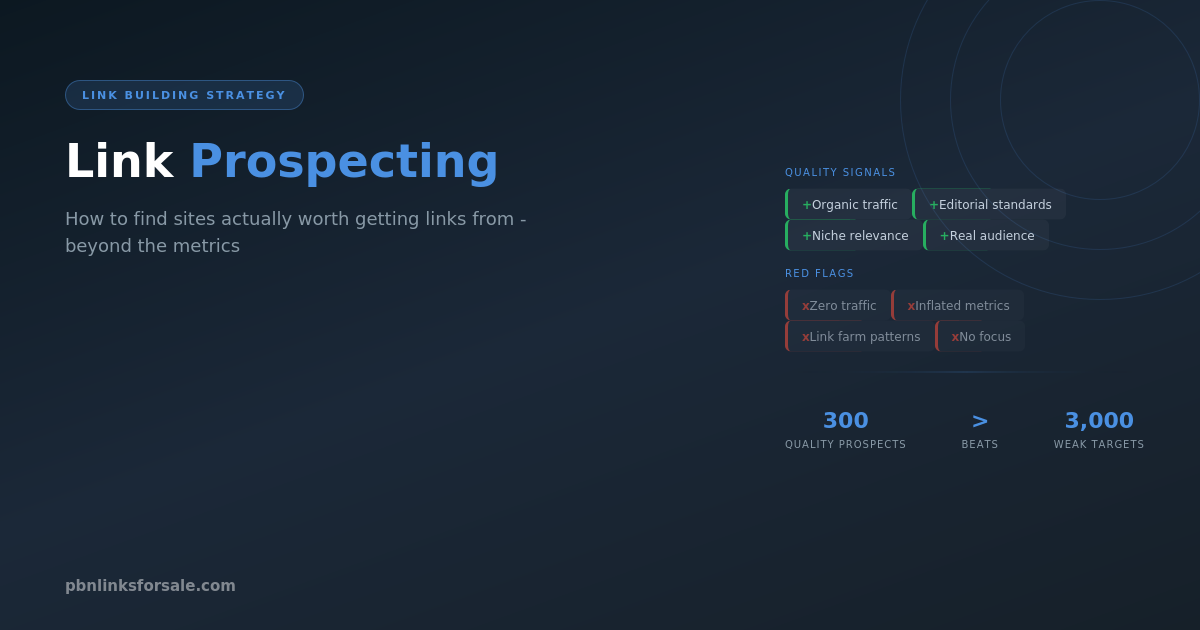
Before examining any other signal, check whether a potential link prospect receives organic search traffic. This single filter eliminates more bad prospects than any other criteria.
The logic is straightforward: A site receiving organic traffic has been validated by Google. Google's algorithms have evaluated that site and determined it deserves to rank for something. That validation signal transfers—at least partially—when that site links to you. You're borrowing credibility from a source Google has already decided to trust.
A site with zero organic traffic has effectively been told by Google that it provides insufficient value to rank for anything. Why would you want a link from a site Google has decided doesn't deserve visibility? The metrics might look fine. The content might seem acceptable. But Google has rendered its verdict, and that verdict is: not good enough to show searchers.
Tools like Ahrefs, Semrush, and Similarweb can estimate organic traffic. The number doesn't need to be huge—even 500 monthly visitors indicates Google finds something valuable enough to rank. But zero or near-zero traffic is a red flag that should override impressive-looking domain metrics.
There's one legitimate exception: Brand new sites in their first few months of existence may not have established organic traffic yet. Google takes time to evaluate and trust new domains. In these cases, you need to evaluate other signals: Is the content genuinely high quality? Does the site appear to be a real project with actual investment behind it? Is there evidence of a real person or team building something legitimate?
When evaluating new sites, we generally recommend waiting. Check back in six months. If the site has developed organic traffic by then, it's demonstrated staying power and earned Google's trust. If it's still at zero traffic after six months of existence, either the content isn't good enough or something else is wrong—either way, it's not a prospect worth pursuing.
Some sites exist purely to monetise link sales. They were created specifically for this purpose and have no genuine editorial mission, no real audience, and no reason to exist beyond extracting money from SEO practitioners desperate for backlinks.
Google knows these sites exist and actively works to identify them. SpamBrain—Google's machine learning system for spam detection—has become increasingly sophisticated at recognising link selling operations. We've seen the consequences when cheap link sources get caught: not just wasted money, but potential negative impact on the sites those links pointed to.
Here are the warning signs that a site exists primarily to sell links:
Content spanning unrelated topics with no editorial focus. Legitimate publications have a niche, an audience, a reason for existing. A site publishing articles about cryptocurrency, pet care, home improvement, legal advice, and travel destinations—with no apparent connection between these topics—is almost certainly accepting content from anyone willing to pay. The editorial calendar is driven by who's buying, not what serves readers.
Mechanical publishing schedules. Real editorial operations have variable output. Some weeks produce more content than others depending on news, resources, and editorial judgment. Sites publishing exactly 3 articles every weekday, 52 weeks a year, regardless of what's happening in their supposed niche, are running content mills designed to create linking opportunities.
Vague or missing identity information. Check the About page. Check the Contact page. Is there a real person or company behind this site? Are there named authors with verifiable credentials? Can you find evidence of this publication existing anywhere besides its own domain? Sites built purely for link selling typically provide minimal identity information because there's nothing real behind them.
No social media presence or community engagement. Legitimate publications build audiences. They have social media accounts with real followers. Their content gets shared and discussed. Link farms don't invest in audience building because they're not trying to serve readers—they're trying to collect fees from link buyers.
Outbound links to random commercial sites. Open several articles on the site and examine their outbound links. If every piece contains links to online casinos, CBD products, payday loans, or other high-value link targets—regardless of the article topic—you're looking at a link selling operation. Real editorial sites link to sources that support their content, not whoever paid for placement.
The most damaging pattern is when multiple sites share obvious characteristics: similar templates, hosting on the same IP ranges, identical contact forms, cross-linking between properties, or suspiciously similar content structures. These networks get identified and devalued—sometimes in a single algorithm update. Your links disappear overnight.
This is why quality matters so much when working with any link source. Providers offering links at rock-bottom prices can only sustain those prices by cutting corners—corners that increasingly trigger algorithmic detection. The sites might look acceptable at first glance. But under scrutiny, the patterns emerge.
A link from a site closely related to your topic carries more weight than a link from an unrelated site with superior metrics. This isn't speculation—it's observable in campaign after campaign. Google's systems understand topical relationships, and links that make contextual sense deliver more ranking impact.
Think about it from Google's perspective. If you run a site about marathon training and receive a link from a respected running publication, that link represents a genuine endorsement. The linking site's audience cares about running. The editorial team presumably knows what's valuable in the running space. Their linking to you signals that you belong in that conversation.
Now consider a link to that same marathon training site from a general lifestyle blog with higher domain metrics but no particular focus on fitness. The link might pass some authority, but the endorsement signal is weaker. The linking site isn't an authority on running. Their audience isn't specifically interested in running content. The contextual relevance is minimal.
Relevance operates on multiple levels, and understanding these levels helps prioritise prospects:
Niche relevance is the broadest level. A fitness site linking to another fitness site. A technology publication linking to a tech startup. The general subject areas overlap.
Topic relevance is more specific. A site focused on running linking to a marathon training site. A cybersecurity blog linking to a password management tool. The specific topics within the niche align.
Page-level relevance is most specific. An article about preventing running injuries linking to a page about recovery techniques. A tutorial on network security linking to a specific security tool that solves the problem discussed. The individual pages are directly related.
When building prospect lists, prioritise sites where your content genuinely fits. Ask yourself: If I were a regular reader of this publication, would a link to my content make sense? Would it add value to the article it appears in? This is why we always emphasise niche-relevant backlinks over generic placements—the relevance signal compounds the authority signal.
Spend actual time on a site before adding it to your prospect list. This sounds obvious, but it's routinely skipped. Link builders assemble lists of thousands of sites they've never visited, then wonder why outreach response rates are abysmal and acquired links don't move rankings.
What you're looking for is evidence of genuine editorial standards. Not perfection—but care. Signs that someone is actually trying to create something valuable rather than manufacturing content-shaped filler.
Read several articles critically. Is the writing competent? Does it provide actual information or just circle around a topic without saying anything? Could this content have been generated by asking an AI to write 500 words about a keyword with no further input? Quality content has a point of view, includes specific details, and feels like it was written by someone who knows the subject.
Check author information. Are there bylines from real people? Can you verify those people exist? Do the authors have credentials relevant to what they're writing about? A site publishing medical content with no identifiable medical professionals is a site Google may well distrust—and by extension, a site whose links may carry reduced value.
Assess the user experience. Is the site designed for readers or for search engines? A site with ten ads above the fold, auto-playing videos, and pop-ups appearing every thirty seconds has optimised for monetisation over user experience. Google factors user experience signals into rankings, and sites that frustrate users tend to face ranking pressure over time.
Examine existing outbound links. What other sites does this publication link to? Are those links to legitimate, helpful resources—or to a random assortment of commercial sites that paid for placement? The company a site keeps tells you a lot about its editorial standards.
The sites linking to your prospect site reveal how Google likely perceives it. A prospect with a healthy backlink profile probably has real authority to pass. A prospect with a spammy backlink profile has likely inflated its metrics artificially—and may be one algorithm update away from losing whatever authority it appears to have.
Pull the prospect's backlink profile using Ahrefs, Semrush, or similar tools. Look at the overall pattern rather than individual links.
A healthy backlink profile shows diversity. Different types of sites linking in: blogs, news sites, educational institutions, forums where relevant, social references. A mix of followed and nofollowed links. Links acquired over time rather than in suspicious bursts. Anchor text that looks natural—mostly brand mentions and naked URLs, with keyword-rich anchors appearing occasionally rather than dominating.
Warning signs include profile concentration. If 80% of a site's links come from one type of source—especially low-quality directories, Web 2.0 properties, or foreign language sites with no apparent connection to the content—someone has been building links artificially. That artificial foundation can crumble.
Watch for link velocity anomalies. Natural link acquisition is generally gradual, with occasional spikes when content gets attention. A profile showing sudden massive link acquisition followed by long periods of nothing suggests artificial campaigns. Those artificial links may be devalued at any time.
If a prospect has built its own authority through questionable link building, the authority it can pass to you is compromised. You're only as strong as the weakest link in the chain. This connects to why link decay happens—when the sites linking to your link sources lose authority, that degradation cascades to you.
Now that you know what to look for, let's discuss where to find it. Different prospecting methods yield different types of opportunities, and the most effective campaigns draw from multiple sources.
This remains the most reliable prospecting method. If a site has already linked to your competitors, they've demonstrated willingness to link to sites in your space. They've proven interest in your niche. They may even have an editorial gap you can fill. We've written extensively about reverse engineering competitor backlinks—the methodology there applies directly to prospecting.
Export the backlink profiles of 5-10 direct competitors. Identify sites linking to multiple competitors—these are clearly active in your space and receptive to link requests. Apply the quality filters discussed above to eliminate weak prospects. What remains is a list of sites predisposed to consider your outreach.
Look especially for links competitors earned to specific content types: guides, research, tools, resources. If you can create something comparable or better, you have a clear pitch: "You linked to X's guide on this topic. We've published something more comprehensive/updated/detailed—thought you might want to know about it."
Resource pages exist specifically to link out. Their entire purpose is pointing readers toward helpful content. This makes the conversion rate higher than generic outreach—you're not asking someone to add a link to content that wasn't designed to include external references.
Search operators help surface these pages: "keyword + resources," "keyword + useful links," "keyword + recommended reading." Review the results through your quality filters. Many resource pages live on low-quality sites and aren't worth pursuing. Focus on resource pages hosted on legitimate publications with actual traffic.
The pitch is straightforward: "I noticed your resource page on [topic]. We've published [content description] that might be valuable to your readers." Keep it concise. The resource page owner evaluates dozens of similar requests; respect their time.
Broken link building identifies dead links on quality sites and offers your content as a replacement. The prospecting angle is finding pages with broken outbound links to content similar to yours.
Tools like Ahrefs can surface broken outbound links across a domain. Filter for broken links that previously pointed to content in your niche. Verify the linking pages are actually worth pursuing (apply all quality criteria). Check that you have content genuinely suited to replace what disappeared.
This method provides genuine value to the site owner. You're helping them fix a problem—broken links create poor user experiences. That value exchange makes the pitch warmer than standard link requests. The conversion rates reflect this.
Publications serving your industry often accept contributed content. The barrier to entry is higher—they have editorial standards and reject most pitches. But the link value reflects that selectivity. A link from a respected industry publication carries genuine endorsement weight. This is where guest posting becomes valuable—when it's placement on real publications with real audiences, not content mills disguised as blogs.
Build a list of publications your target audience actually reads. Industry magazines. Niche blogs with genuine followings. News sites covering your sector. Professional association publications. These become long-term relationship targets rather than one-off link grabs.
Sometimes sites mention your brand or content without linking. These represent warm prospecting opportunities—the site owner already knows you exist and found you worth mentioning. The conversion request is simply asking them to make the existing mention clickable.
Set up Google Alerts for your brand name, product names, and key content titles. Monitor for mentions that don't include links. Reach out with thanks for the mention and a polite request to add a link for readers who might want to learn more.
This also works retroactively. Tools can surface historical mentions that never received links. The older the mention, the less likely the site owner remembers the context—but it's still worth trying. The worst outcome is no response, and the existing mention remains.
Prospecting shouldn't be a one-time project that generates a list you work through and abandon. The most effective link builders maintain ongoing systems that continuously surface new opportunities.
Set up ongoing monitoring. Use tools or alerts to track new content published in your niche. When a new site emerges and starts gaining traction, evaluate it early. Building relationships with emerging sites while they're still growing can yield ongoing opportunities that become increasingly valuable as those sites develop authority.
Track what converts. Not all prospect types perform equally for all campaigns. Over time, patterns emerge. Maybe certain sub-niches respond better to your outreach. Maybe certain content formats attract more links. Use this data to refine prospecting criteria rather than treating all prospect types as equivalent.
Document disqualification reasons. When you remove a site from consideration, note why. After several months, you'll have a custom checklist of red flags specific to your niche. New team members can prospect effectively faster. You'll waste less time on sites you've already evaluated and rejected.
Refresh old prospects periodically. Sites change. A prospect you rejected six months ago because it had no traffic might have developed an audience. A site that was perfect last year might have been sold and filled with sponsored content. Quarterly reviews of your rejected and acquired lists keep information current.
Build relationships, not just links. The best prospecting produces ongoing partnerships rather than single transactions. A site that links to you once and had a good experience is likely to link again. Treat prospects as potential long-term collaborators, not just link sources to extract value from.
There's a temptation to build massive prospect lists in the belief that more targets equal more links. If 5% of prospects convert, surely 10,000 prospects are better than 1,000?
The math doesn't work that way in practice.
Each prospect you add to a list represents time: time to research the site, time to find the right contact, time to craft a personalised pitch, time to follow up. With a massive list of loosely-vetted prospects, you either spend huge resources on outreach or resort to templated approaches that tank response rates.
More importantly, time spent on low-quality prospects is time not spent on high-quality ones. The opportunity cost compounds. While you're chasing sites that will never deliver real value, competitors are building relationships with sites that actually matter.
We've tested this repeatedly. Campaigns targeting fewer, carefully-vetted prospects consistently outperform campaigns with larger lists of loosely-filtered sites. The links are better. The response rates are higher. The relationships lead to repeat opportunities. The ranking impact per link is greater.
A list of 300 genuinely qualified prospects will produce better results than a list of 3,000 sites that merely passed basic metric thresholds. The prospecting effort is the same or less, and everything downstream—outreach, negotiation, content creation—becomes more efficient because you're working with better opportunities.
Prospecting is time-intensive. For many teams, the question becomes whether to invest that time internally or leverage external resources.
In-house prospecting makes sense when you have team members with genuine expertise in your niche, when building industry relationships is a strategic priority beyond link building, and when you have the bandwidth to do it properly without it becoming an afterthought that produces weak results.
External support makes sense when you need to scale link building faster than internal resources allow, when your team's time is better spent elsewhere in the marketing operation, or when you lack the tools and expertise to prospect effectively. Working with providers who maintain their own vetted prospect networks—whether for PBN placements, niche edits, or guest posts—can eliminate the prospecting burden entirely.
The key with external providers is vetting their prospecting standards. Ask how they evaluate and select sites for their network. Ask about rejection rates—if they accept everything, quality suffers. Ask what happens when a site in their network degrades. The provider's prospecting methodology determines whether their links help or hurt you.
Good prospecting requires a fundamental shift in how you think about link opportunities. Stop chasing impressive-looking metrics. Start asking whether a site represents a genuine endorsement worth having.
Would you be proud to see your link on this site? Would Google view a link from here as a credible signal of your content's value? Would a real person in your target audience be likely to click through?
If the answers are yes, pursue the opportunity. If the answers are no—regardless of what the metrics say—your time is better spent elsewhere.
The extra effort invested in prospecting pays compound returns. Better prospects mean higher response rates, faster conversions, more valuable links, and ranking improvements that justify the investment. Poor prospects mean wasted outreach, disappointed expectations, and links that don't move the needle.
Do the work upfront. Build lists you're proud of. Whether you're pursuing prospects yourself or working with link building partners who do it for you, the same principle applies: quality of opportunity determines quality of outcome.
Everything else in link building—outreach, negotiation, content, placement—follows from prospecting. Get it right, and the rest becomes dramatically easier. Get it wrong, and no amount of skill in execution can compensate.







2025 © Copyrights PBN Links For Sale

Stop struggling with SEO. Our expert team will analyze your website and create a custom backlink strategy that delivers real results. Get more traffic, more leads, and more revenue.
Take the first step towards expanding your business online with our Backlinks services. We work with many private individuals and SEO agencies. We can help you take care of all your Backlink needs and rank your websites correctly. Boost your website's rankings today!


Find the perfect solution for your SEO and link building needs
Browse our full range of quality backlinks and SEO services
Shop NowComplete packages for every budget and ranking goal
View PackagesWhite-label solutions for agencies and resellers
Agency PlansProfessional SEO services at competitive prices
Learn More