'How many links can I build per month without triggering a penalty?'
'How many links can I build per month without triggering a penalty?'


We can assure you, that we only place your backlinks in super high-quality PBN Networks that are both safe and reliable. With a limited amount of selling in each site.

PBNs can be quite tricky, and having been burned in the past I was very apprehensive. But their service happens to be quite safe as my website has not seen any penalties. On the contrary, we’ve seen an increase in rankings.

I must say, quite an affordable service for the quality delivered. The links are well placed and the websites look genuine for the most part. I’ll be back again.
'How many links can I build per month without triggering a penalty?'
I get asked this constantly. And the honest answer is frustrating: it depends. But not in a vague, unhelpful way—it depends on specific, identifiable factors that you can actually assess for your situation.
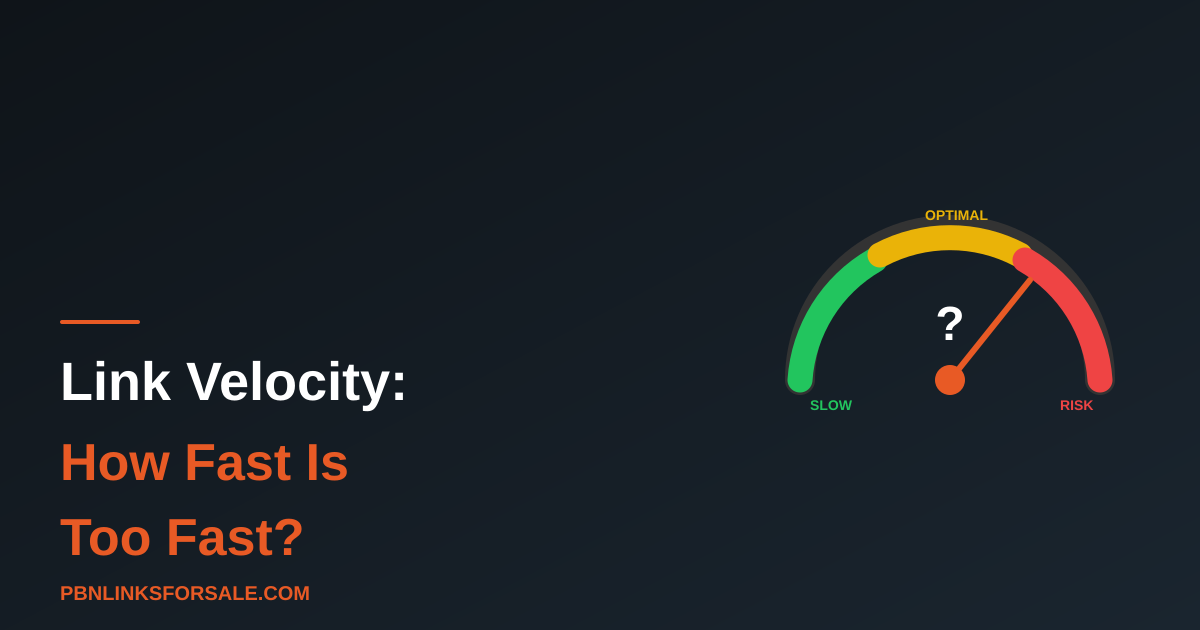
Link velocity—the rate at which you acquire new backlinks—matters. Build too slowly and you'll never catch competitors. Build too fast and you risk looking manipulative. The sweet spot varies dramatically based on your starting position, your niche, and the types of links you're building.
Google looks at link acquisition patterns, not just link totals. A site that suddenly gains 500 backlinks in a week after months of nothing looks different from a site that's been steadily gaining 20 links per week for years.
This makes sense from Google's perspective. Natural link acquisition has patterns. A new piece of content might attract a burst of links when it's published and promoted, then taper off. A site that's genuinely growing in authority tends to attract links at an increasing but relatively steady rate. Viral content creates spikes. Seasonal businesses see predictable fluctuations.
Manipulated link profiles often look different. Sudden massive spikes with no apparent cause. Perfectly steady acquisition that never varies. Patterns that don't match anything happening on the actual site. These anomalies can trigger scrutiny.
The goal isn't to game the pattern—it's to understand what looks natural for your situation and operate within that range.
Your existing velocity baseline. If your site has been acquiring 10 new referring domains per month for the past year, suddenly jumping to 200 looks suspicious. But if you've been acquiring 100 per month, bumping to 150 is barely notable. Your historical pattern sets expectations.
Your site's age and authority. We covered this in detail when discussing new sites versus established sites—but the short version is that established sites can absorb higher velocity than new ones. A brand new domain acquiring 50 links per month looks suspicious. A 10-year-old authority site acquiring the same looks normal.
Your competitors' velocity. In highly competitive niches, aggressive link building is normal. Everyone's doing it. In sleepy niches where competitors barely build links, aggressive acquisition stands out more. Context matters.
What's happening on your site. Link velocity should roughly correlate with activity. Launching a major new product? Running a PR campaign? Publishing viral content? Those justify link spikes. Doing nothing different while links mysteriously flood in? That's harder to explain.
The types of links you're building. High-quality editorial links can be acquired faster than spammy links without raising flags. Ironically, quality provides cover for velocity. Google's systems are better at detecting spam patterns than legitimate-looking link acquisition.
I'm hesitant to give specific numbers because context matters so much. But people want benchmarks, so here are rough guidelines with the understanding that your situation may differ:
Brand new sites (0-6 months): Start very conservatively. A handful of links per month—maybe 5-15 referring domains—while you establish baseline patterns. Focus on foundational links: citations, social profiles, a few relevant niche links. Don't try to compete on velocity yet.
Young sites (6-18 months): Gradually increase. Maybe 15-40 referring domains per month depending on niche competitiveness. You've got some history now, so slightly more aggressive acquisition looks reasonable. Still emphasise quality and relevance over raw numbers.
Established sites (18+ months with existing profile): More flexibility. 30-100+ referring domains per month can be sustainable depending on your baseline and niche. You can run more aggressive campaigns, absorb larger link packages, and generally operate with less caution.
Authority sites (years old, strong existing profile): The ceiling is much higher. Major brands acquire hundreds of links monthly through normal operations. If you're already at that level, maintaining or increasing velocity is expected, not suspicious.
These are starting points for thinking, not hard rules. A new site in an aggressive niche might safely build faster. An established site with a suddenly spiking velocity and no explanation might still trigger scrutiny.

In practice, velocity issues usually stem from combinations of factors rather than velocity alone:
High velocity + low quality. Building lots of spammy links quickly is the classic penalty trigger. The velocity makes the spam more visible. If you're going to build volume, quality has to hold up.
High velocity + unnatural patterns. All links from one country. All links using the same anchor. All links appearing on the same day of the week. Patterns that scream 'automated' combined with high velocity are problematic.
High velocity + no site activity. Your site hasn't published anything in months. Nothing newsworthy has happened. But suddenly links are pouring in. The disconnect is obvious.
High velocity + new domain. As discussed, new sites need to build trust before they can build volume. Skipping that step rarely works.
Velocity alone, with quality links and natural patterns, rarely causes problems. It's the combination with other signals that creates issues.
One thing that matters as much as absolute velocity is consistency. Steady acquisition over time looks more natural than sporadic bursts.
Building 20 links per month for 12 months looks very different from building 240 links in one month then nothing for a year—even though the total is the same. The first pattern suggests ongoing authority growth. The second suggests a one-time manipulation attempt.
This is one reason why consistent, ongoing link building tends to outperform sporadic campaigns. Beyond the compounding effect of steady acquisition, the pattern itself looks healthier to Google's systems.
That said, some variation is natural and even expected. Content launches create spikes. PR coverage creates spikes. Perfectly flat acquisition actually looks more artificial than natural fluctuation. Aim for 'generally consistent with occasional explainable spikes' rather than 'robotically identical every month.'
If you want to increase your link building velocity—maybe you've got more budget, or you're entering a more competitive phase—do it gradually rather than all at once.
If you've been building 20 links per month and want to get to 60, don't jump straight there. Go to 30 for a couple of months. Then 40. Then 50. Then 60. Let your baseline shift gradually so each increment looks like natural growth rather than a sudden strategic change.
This applies to scaling down too. If you've been building aggressively and need to reduce, taper rather than stopping abruptly. A sudden halt after months of heavy building can look almost as suspicious as a sudden spike.
I'll be honest: a lot of velocity anxiety is overblown.
Google's systems are sophisticated enough to understand that link acquisition isn't perfectly predictable. They're looking for obvious manipulation signals, not minor variations in monthly totals. If you're building quality links at a reasonable pace with natural diversity, you're probably fine.
The people who get in trouble aren't usually the ones carefully managing velocity—they're the ones buying thousands of garbage links, using obviously manipulated PBNs, or doing things that would look sketchy regardless of velocity. If you're building quality, velocity management is refinement, not survival.
Focus first on link quality and relevance. Then on natural anchor distribution. Then on velocity. It's the third consideration, not the first.
Match your velocity to your site's age and existing baseline. New sites go slow; established sites have more flexibility.
Prioritise consistency over volume. Steady monthly acquisition beats sporadic bursts.
Scale gradually when increasing velocity. Let baselines shift naturally.
Velocity problems usually involve other factors—low quality, unnatural patterns, no site activity. Fix those first.
Don't overthink it. Quality links at a reasonable pace with natural variety rarely cause issues. Build well and velocity takes care of itself.





2025 © Copyrights PBN Links For Sale

Stop struggling with SEO. Our expert team will analyze your website and create a custom backlink strategy that delivers real results. Get more traffic, more leads, and more revenue.
Take the first step towards expanding your business online with our Backlinks services. We work with many private individuals and SEO agencies. We can help you take care of all your Backlink needs and rank your websites correctly. Boost your website's rankings today!


Find the perfect solution for your SEO and link building needs
Browse our full range of quality backlinks and SEO services
Shop NowComplete packages for every budget and ranking goal
View PackagesWhite-label solutions for agencies and resellers
Agency PlansProfessional SEO services at competitive prices
Learn More