

We can assure you, that we only place your backlinks in super high-quality PBN Networks that are both safe and reliable. With a limited amount of selling in each site.

PBNs can be quite tricky, and having been burned in the past I was very apprehensive. But their service happens to be quite safe as my website has not seen any penalties. On the contrary, we’ve seen an increase in rankings.

I must say, quite an affordable service for the quality delivered. The links are well placed and the websites look genuine for the most part. I’ll be back again.
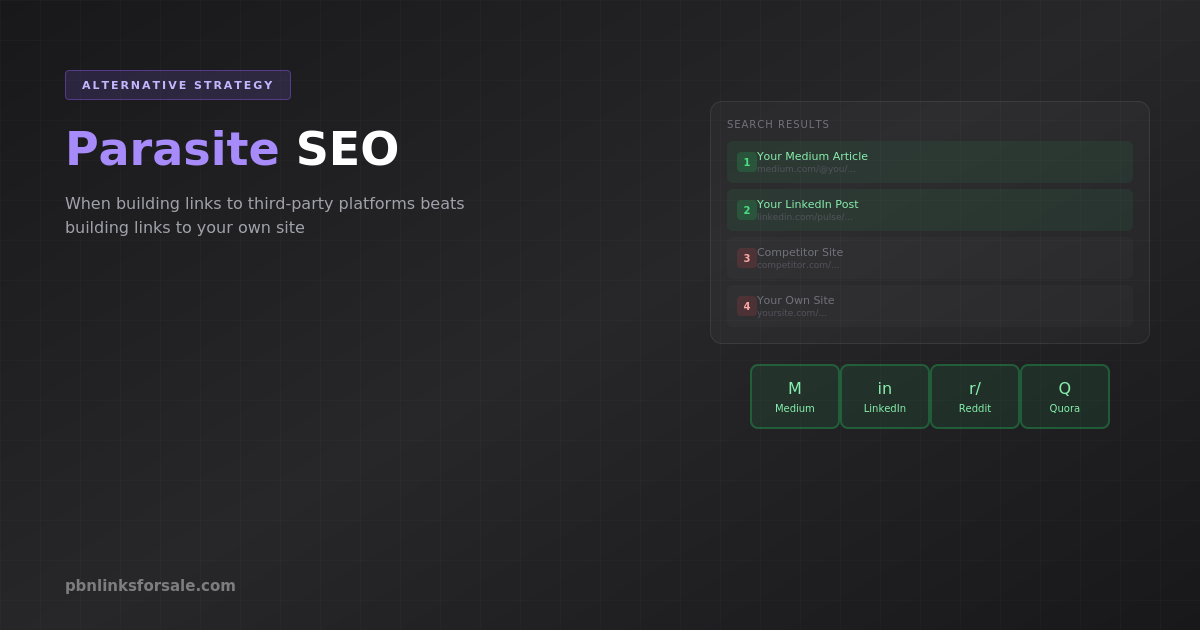
Sometimes the fastest path to ranking isn't building links to your own site. It's placing your content on sites that already have the authority to rank, then letting those pages do the heavy lifting. This approach—variously called parasite SEO, barnacle SEO, or platform SEO—flips traditional link building on its head.
Instead of building authority for your domain over months or years, you leverage existing authority on established platforms. Your content lives on Medium, LinkedIn, Reddit, or industry publications that already rank. Links point to those pages, boosting content you control on domains you don't own.
This guide covers when parasite SEO makes strategic sense, which platforms work best, how to execute effectively, and the risks you're taking. For some situations, this approach delivers results that traditional link building can't match. For others, it's a dangerous distraction.
Parasite SEO uses established platforms to rank for keywords you can't rank for on your own site. You create content on high-authority domains, optimise that content for target keywords, and sometimes build links to boost those pages further.
A new website targeting "best CRM software" faces an almost impossible challenge. The top results are dominated by massive authority sites. Building enough authority to compete could take years and substantial investment.
But a detailed CRM comparison posted on Medium, LinkedIn, or a major industry publication starts with that platform's existing authority. The content may rank quickly—sometimes within days—because the domain already has Google's trust.
The "parasite" terminology reflects how this works: your content benefits from the host platform's authority without contributing to it. You're extracting ranking value from their domain strength.
Parasite SEO exists on a spectrum. Publishing genuinely helpful content on platforms where it serves readers is legitimate content distribution. Spamming low-quality content across platforms purely for rankings is manipulation.
Google's March 2024 "site reputation abuse" policy targets the manipulative end—specifically, third-party content published primarily to exploit a site's ranking signals. We've covered Google's war on parasite SEO in detail elsewhere. Legitimate uses that provide genuine value face less risk.
The distinction matters for sustainability. Approaches Google considers manipulative get targeted eventually. Approaches that genuinely serve users tend to survive algorithm updates.
Certain situations favour parasite approaches over traditional link building.
New domains face a cold start problem. Even excellent content struggles to rank without domain authority. Building that authority takes significant time and investment.
Parasite SEO can generate traffic and conversions while your own site's authority develops. It's a bridge strategy—capturing opportunity now while building long-term assets on your own domain.
Some keywords are so competitive that ranking your own site is effectively impossible. The top results have domain authorities of 80+ with thousands of linking domains to specific pages.
For these keywords, parasite SEO may be the only viable path to organic visibility. A high-authority platform may be able to rank where your domain never could, regardless of how many links you build.
Before committing major resources to ranking for a keyword on your own site, parasite SEO can validate the opportunity. Does traffic from this keyword actually convert? Is the search intent what you assumed?
Testing via platform content is cheaper than building hundreds of links to your own pages for keywords that might not convert. Prove the opportunity first, then invest in ranking your own site.
Some opportunities are temporary. Trending topics, seasonal keywords, or event-related searches may not justify long-term investment. Parasite SEO captures these opportunities quickly without building permanent assets.
If a keyword will only matter for the next three months, building links to your own site may take longer than the opportunity lasts. Platform content can rank quickly enough to capture temporary traffic.
Sometimes the goal isn't direct traffic but brand visibility. Ranking content on LinkedIn, major publications, or industry sites builds brand recognition even if readers don't click through to your site.
This presence creates familiarity. When readers later encounter your brand directly, they recognise it. The parasite content served a brand-building function even without direct conversions.
Different platforms suit different purposes. Choose based on your goals and target audience.
Medium, LinkedIn articles, and Substack allow anyone to publish. They carry significant domain authority and rank well for many keywords. They're accessible but competitive—many others use the same strategy.
These platforms work best for B2B content, thought leadership, and topics where LinkedIn's professional audience or Medium's reader base align with your targets. They're less effective for purely commercial or highly competitive keywords.
Reddit and Quora rank prominently for question-based searches. Answers on these platforms frequently appear in top positions, especially since Google's increased emphasis on forum content.
We've discussed why Google is ranking Reddit and Quora above traditional websites elsewhere. The same dynamics that hurt your own site's rankings create opportunities for parasite SEO on these platforms.
These platforms require genuine participation rather than obvious promotion. Building reputation through helpful answers creates opportunities for strategic content that also serves your interests.
Contributing content to high-authority industry publications is a form of parasite SEO. The article ranks on their domain. You may get a link back to your site, but the primary value is the ranking of the contributed content itself.
This approach requires content quality sufficient for editorial acceptance. It's more difficult than self-publishing platforms but produces more authoritative placements. Industry publications carry topical authority that general platforms lack.
G2, Capterra, Yelp, and industry-specific directories often rank for commercial keywords. Optimising your presence on these platforms—complete profiles, reviews, detailed descriptions—helps your listings rank within those platforms.
This is parasite SEO in a different form: improving visibility on platforms that already rank for your target keywords. You're not creating new content but optimising existing placements.
Platform content often ranks with minimal promotion due to inherent domain authority. But links can boost rankings further, especially for competitive keywords.
For competitive keywords, platform authority alone may not be enough. Links to specific platform pages provide additional signals that help that content outrank competing content on the same platform and across the web.
The math often favours parasite link building: the same links that might move your own site from position 50 to position 30 might move a platform page from position 10 to position 3. The platform's baseline authority creates leverage.
Build links to platform content the same way you'd build links to your own content. Guest posts pointing to your Medium article. Niche edits referencing your LinkedIn post. PBN links to your Quora answer.
The platform's authority means fewer links often produce bigger results. A handful of links that would barely move your own site can push platform content to top positions.
Building links to third-party platforms can feel wasteful—you're investing in assets you don't own. But if the goal is traffic and conversions, ownership matters less than results.
Compare the cost to achieve specific rankings via your own site versus via platform content. When platform approaches are dramatically cheaper, the ownership objection weakens.
Platform content needs to create business value, not just rankings.
The most common approach: platform content links back to your own site for conversions. The article provides value while directing interested readers to your products, services, or deeper content.
This works when the content genuinely justifies the click-through. Readers who find the platform content helpful will click to learn more. Thin content with forced links produces poor click-through rates and suspicious user signals.
Some platform content can convert directly. Contact forms embedded in content. Direct response calls to action. Chat widgets on platform pages where allowed.
Direct conversion removes friction but depends on platform policies. Many platforms restrict commercial activity. Violating terms of service risks losing the content entirely.
Sometimes platform content builds brand rather than driving immediate conversions. Consistent presence across platforms establishes expertise. Readers encounter your brand repeatedly across different contexts.
This indirect value is harder to measure but can be substantial. Brand familiarity affects conversion rates on all channels. Platform presence contributes to recognition that benefits your entire marketing ecosystem.
Parasite SEO carries real risks that traditional approaches avoid.
You don't control the platform. Terms of service can change. Your content can be removed. Your account can be banned. Everything you've built can disappear with no recourse.
This is the fundamental vulnerability of parasite SEO. You're building on rented land. The landlord can evict you at any time for any reason—or no reason at all.
Google increasingly targets site reputation abuse. The March 2024 core update explicitly addressed third-party content exploiting site authority. Future updates may further restrict parasite SEO effectiveness.
What works today may not work tomorrow. Building significant business dependency on parasite SEO creates vulnerability to both platform changes and algorithm changes.
Links to platform content don't build your domain's authority. Years of parasite SEO leave your own site no stronger than when you started. You've captured traffic without building assets. When platforms or algorithms change, you have nothing accumulated. The compounding effect of link building only works when building to assets you own.
Aggressive parasite SEO can damage brand reputation. If your content appears spammy or manipulative, readers associate those qualities with your brand. The short-term traffic may not be worth long-term reputation damage.
The most effective strategy usually combines both approaches.
Parasite SEO delivers short-term results. Traditional link building to your own site delivers long-term compounding. A balanced approach captures immediate opportunity while building lasting assets.
Consider allocating effort: perhaps 30% to parasite approaches for immediate traffic, 70% to traditional approaches for long-term growth. The exact balance depends on how urgently you need results versus how much you value long-term assets.
New sites can use parasite SEO to generate revenue while building their own authority. The platform traffic funds link building to owned properties. Over time, shift emphasis toward your own site as its authority grows.
This bridge strategy captures opportunity without abandoning long-term goals. The parasite content is temporary scaffolding, not permanent structure.
For important keywords, consider ranking both your own site and platform content. Multiple positions in search results capture more traffic and push competitors down.
This approach requires more total investment but maximises keyword visibility. Even if readers click the platform result instead of your site, they encounter your brand and content.
If using parasite SEO, execute thoughtfully.
Platform authority helps content rank, but quality determines whether it stays ranked and converts. Thin content may achieve temporary rankings but won't survive algorithm refinements or platform moderation.
Invest in content quality for platform posts just as you would for your own site. The platform provides authority; you still need to provide value.
Violating terms of service risks losing everything you've built on that platform. Understand what's allowed. Stay within boundaries. The temporary advantage of rule-breaking isn't worth the permanent disadvantage of account termination.
Don't depend on a single platform. Spread parasite content across multiple platforms to reduce vulnerability to any single platform's changes. If Medium adjusts policies, your LinkedIn content continues working.
Measure which platform content actually drives business value. Rankings alone don't matter—conversions do. Invest more in what works, abandon what doesn't, and continuously optimise your platform presence.
The answer depends on your situation:
New site needing immediate traffic? Parasite SEO can bridge the authority gap while you build long-term assets.
Targeting impossible-to-rank keywords? Platform content may be your only viable path to organic visibility.
Building a long-term brand? Traditional link building to owned properties creates more sustainable value.
Risk-averse with established business? Platform dependency creates vulnerability that may not suit your risk profile.
Most businesses benefit from some parasite SEO for specific purposes while primarily building their own site's authority. Pure parasite strategies create fragile businesses dependent on platforms you don't control. Pure traditional strategies may miss opportunities that platform presence could capture.
The strategic question isn't whether to use parasite SEO, but when and how much. Used thoughtfully as part of a broader strategy, platform content extends your reach. Used as a primary approach, it builds a business on foundations you can't control.
Build assets you own. But don't ignore opportunities to capture value while those assets develop.






2025 © Copyrights PBN Links For Sale

Stop struggling with SEO. Our expert team will analyze your website and create a custom backlink strategy that delivers real results. Get more traffic, more leads, and more revenue.
Take the first step towards expanding your business online with our Backlinks services. We work with many private individuals and SEO agencies. We can help you take care of all your Backlink needs and rank your websites correctly. Boost your website's rankings today!


Find the perfect solution for your SEO and link building needs
Browse our full range of quality backlinks and SEO services
Shop NowComplete packages for every budget and ranking goal
View PackagesWhite-label solutions for agencies and resellers
Agency PlansProfessional SEO services at competitive prices
Learn More